Saturday, April 5, 2014

Day 32 - Perry to St. Petersburg, Florida

Well, here we are, finally, in the land of dripping foreheads. Up until now, spring in the southeast has been very, very kind to us. Very little rain has fallen, and wonderfully cool temperatures have been the norm all the way from Texas to eastern Florida. But last night, as we set up camp in Perry, both the heat and the bugs gently settled into our lives, and we knew that the party was over. Last night I looked up the weather stats on the Web just to see what was what in St. Petersburg, our intended destination for today. The week's worth of charts informed me that come next week we could expect rain. In the meantime, we could just go ahead and expect 97% humidity. Damn! I had no idea you could even experience 97% humidity anywhere outside of the country of Panama.

No matter. We're just going to forge ahead and kick the air conditioner up a few notches to HIGH, take twice as many showers as before, and drink more adult beverages containing ice cubes -- lots of ice cubes. I may even switch from my Levis to a pair of shorts for the first time on this trip. Yes, I know what you're thinking, but something as insidious as 97% humidity calls for drastic measures.

Today was a day where nothing much happened. Hoping to arrive in Naples, Florida, by Sunday night, we didn't spend much time today trying to find things to distract us from driving. We stopped for gas. We stopped for supplies at Wally World. We stopped at Home Depot hoping to find a spray bottle of Krud Kutter, which is a staple in Nevada's Home Depot. Krud Kutter is the only product that I've found that takes squashed bugs off various RV surfaces with ease. Unfortunately, the folks at Home Depot here in Florida hadn't gotten the memo that I would be stopping, and had failed to stock up on my favorite bug juice.

Around lunch time we pulled off Highway 19 in response to a brown sign which said, Crystal River Archeological Site. We're always eager to tour a site where people are digging up pot sherds and arrowheads from hundreds or even thousands of years ago. This particular site contained a small museum as well as a series of trails that wandered around some Native American burial mounds next to the Crystal River. It was sort of weird to stand atop the Indian mound and watch fun-seekers speed by in their motorboats (photo lower right). By the way, my junior archaeologist wife says I have to say projectile points, not arrowheads. Sigh!

We did get to watch an interesting demonstration at the archaeological museum, that of the resident ranger throwing a reproduction spear using an Atlatl (pronouced, despite the ranger's protestations, "At Latle." Though I had read much on the subject over the years, I had never seen one thrown by a human. Though the ranger was sort of a Barney Fife type of guy (photo bottom left), he succeeded quite nicely in throwing the spear. In fact, he was so fast I couldn't get a photo of him. He was either holding the Atlatl, ready to thrown, or he'd already thrown it. Guy had obviously had lots and lots of practice over the years as he demonstrated his technique to tourist groups.

If you're thinking of traveling route 19 down from Tallahassee, I'd have to advise you that the first half, as far as Perry, was quite scenic. However, from Perry south the road turns into more of a urban corridor and you do a lot more stopping at lights. In addition, the closer you get to St. Petersburg the more rundown and seedy the scenery becomes along the highway. Next time I would probably choose a different route, at least from Perry south.

Right now we're holed up in the St. Petersburg KOA camp, which is SO popular with the tourists that nearly every camp spot is occupied. As we pulled up I just knew we were wasting our time since the place looked like Disneyland on a busy day. There were people everywhere. The check-in line was five people deep when I got inside. Still, the lady took pity on me when I finally stood before her. Since I said I'd be willing to park anywhere, even if it meant no utilities, she gave us a spot and a guide to find it with. Before we knew it, we were set up in a nice, tree shaded, level spot. Moments later all of our utilities were attached and functioning. Then we were frantically gathering up our laundry for a clandestine foray to the laundry room to see if we could slip in, wash our clothes, and get out again before all the folks got out of the swimming pool and found out that they had no dry clothes to put on. This we did in fine style, though that was scarcely believable as well.

Naturally, with such a clientele, attaching to the WiFi is an exercise in futility. The guy who led me to our spot even admitted that his son used the WiFi to stream videos and isn't that wonderful!!!! Yeah, I thought, just wonderful. But my trusty uplink device (or d'vass if you prefer) does just fine. The only problem is Concetta can't get her super modern IPad d'vass to even talk to the WiFi here, something which happens more often than not.

That's it, then. We're planning on hanging around a few days in Naples before we head north again, this time on the east coast of Florida. Got some folks to visit in Jacksonville, and we can't wait to visit St. Augustine. After that it's Savannah and Charleston. Sounds good to me. I can't wait.

Friday, April 4, 2014

Day 31 - Bonifay to Perry, Florida

I know there are those reading this humble ramble who get tired of hearing me say so, but today was just a totally awesome day and one of the best we've had. We were treated to both history and garden esthetics today and you just can't get any better than that.

Last night, you will remember, we camped about 90 miles west of Tallahassee in the tiny hamlet of Bonifay. There, we were blessed with a nearly level site, great views, gentle temperatures, and completely genial park employees. The WiFi was, as is so often true, nearly non-functional. But other than that, everything was perfect. Tonight, here in Perry, Florida, there's only about six of us in the whole camp and both Concetta and I have been able to log on without difficulty.

This morning's 90-mile ride into Tallahassee was accompanied by our current exciting book on CD, "The English Assassin," by Daniel Silva, and so the time went by in a flash. Interstate 10 is a wonderful bit of pavement, is separated east and west by a huge grassy median, and our side was not very crowded at all. I was able to put the RV on cruise control, sit back, and enjoy the book the whole way.

Our first stop of the day was scheduled to be the Mission at San Luis on the outskirts of Tallahassee. From our reading we had determined that we might be able to see some archeological work in progress and this is a subject in which we both are extremely interested. The GPS had no trouble finding the mission and we were soon browsing through the museum and book store and learning the background for this nearly three-hundred-year-old site.

Once finished with the museum, we found our way to the rear exit and walked out into what was to become one of our most memorable Chautauqua-style experiences of the trip. Not really realizing what was in store, we wandered over to a huge, mound-shaped, grass-covered structure that looked like Gilligan might have stayed there once upon a time. Nothing could be further from the truth. This structure, actually covered with palm fronds, turned out to be three stories high and capable of sheltering up to two thousand people. No grass hut, this!

Once inside, we learned that a Native American tribe known as the Appalachee had constructed the original meeting house. The current meeting house was a modern reconstruction using original-style materials and was built on the original site dating to the 1700s. But these materials were not for the faint of heart. In the center of the building was a sort of Stonehenge-style circle of giant tree trunks with other giant trees tying the tops together. Further out, another circle of tree trunks and lintels were fashioned. Against this outer circle of logs the builders had leaned vertical logs, some short and some as long as thirty feet. Then much smaller limbs were tied to these "rafters" over which the palm fronds were woven. I must say I was very, very impressed. Even using a boom truck or crane, I could see where you might have trouble building this structure. Without any mechanized equipment, I don't know how the original builders did it.

While Concetta and I explored the meeting house, we encountered a Chautauqua docent who told us the whole story of the

events that would normally take place inside the meeting house three centuries ago. I'm not sure why, but I'm always surprised by the complexity of the Native American societies. Inside the meeting house, ringing the outer wall, were rack after rack where bedrolls could be laid out for visiting tribal members from afar. Coming in from the center of the meeting house, and placed in a ring, were lower racks where all the immediate members of the council would sit. On the East side of this ring sat the Chief. Opposite him, a break in the wall offered entrance to the meeting house. The entrance was kept very low, headroom wise, to force entrants to be in a bowing position as they entered. The docent told us that no weapons were allowed in the meeting house.

Our next encounter, once we left the meeting house, was a blacksmith working at his forge. Though his operation was small, the blacksmith was dressed appropriately and handled his tools with skill. We lingered for many minutes talking with the blacksmith about the making of charcoal, needed for the blacksmithing process, and the forging of tools in colonial times and before. Unlike in Nevada's old west period where charcoal kilns were erected as sort of beehive-shaped structures, in Florida they tended to dig a big hole, fill the hole with wood that they set on fire, and then cover the whole affair with dirt to await the wood turning to charcoal. Seems like a crude way of doing it, but that's what the blacksmith told us.

From the blacksmith shop we trekked further to the north and visited the stockade. Though all the buildings on the Mission property are reconstructions, they have gone to no small amount of trouble to make sure your Chautauqua experience is one you'll remember. When we got to the stockade there were two young men to help us visualize the military experience. After that, it was a Franciscan Friar who, though not quite believable enough for Concetta, turned out to be a friendly, amiable kind of guy who made a valiant effort to answer our questions and discuss the state of religious teachings in the new world at the time.

And so the day got off to a really fine start. Nothing is more fun for us than learning about history from folks who love it as much as we do. In addition, walking the beautiful mission grounds was a real treat and we captured many photographs in the process. The grounds were so peaceful that we went ahead and had our lunch right there before we started off in search of our next conquest, the Alfred B. MaClay Gardens State Park. The gardens were said to encompass some 1,184 acres of camellias, azaleas, magnolias, and dozens of other flowers and trees. It sounded just like our kind of place.

Though our route that morning from Interstate 10 to the San Luis mission was rather circuitous, I thought I could probably navigate us back the way we had come. Wrong! In short order I had planted our thirty-foot rig smack dab in the middle of a tiny residential neighborhood with roads just slightly wider than we were. For the next fifteen or twenty minutes we wandered aimlessly, more or less in what I thought was the direction of the Interstate and about the time I thought we better plug in the GPS for the next town and forget the gardens, we passed right over Interstate 10 and continued on north. Well, at least I knew where it was now.

Grabbing the next right so I could parallel the Interstate long enough to find an on-ramp, I had Concetta plug in the MaClay Garden address just to see if it was close. Wonders, of course, don't ever cease, and the Garden property was about a half mile from us. The GPS did attempt to have some fun at our expense and asked us to turn right instead of the required left into the gardens as we approached. This necessitated me performing one of my famous U-turns off a six lane highway in a thirty-foot rig without getting t-boned, but it worked and we were soon rolling down the entrance drive and right into heaven.

Traffic was pretty light at the MaClay gardens, at first I thought it was just us and two women in the whole 1100 some odd acres. Later we would discover others, but it didn't seem to matter as there was more than enough paradise for all of us. We found just masses of flowers everywhere, punctuated by huge old trees dripping Spanish moss, and incredible vistas of lakes and ponds. Although there is an orderly brick path that meanders through the park, you don't have to stay on the path, but can take off in any direction you want following grassy or dirt paths that wander in all directions. At one point, as I was bushwhacking around looking for good photographic vantage points, I emerged from a copse of bushes to find a startled couple standing there staring at me. Thinking fast I said, "Doctor Livingston, I presume?" Which sent them off in gales of laughter. Great fun indeed!

You could really take a picnic lunch and spend all day at the MaClay garden and not regret the time spent at all. But the sun was dropping lower and lower in the sky and we just had to get on the road. Bidding farewell to the Gardens about 3:00 p.m., we rolled south until we found the Interstate, set our course east and kept on the lookout for highway 19 which promised to send us off in a southerly plunge into the peninsular part of the state of Florida.

Once we found highway 19 we were in clover. The road was not very busy, the passing scenery was tranquil and rural, and all we had to do by the end of the day was find the tiny hamlet of Perry where there promised to be a KOA just waiting for the Happy Wanderers.

So it was, that by 4:00 p.m. or so, I was standing in front of a pretty southern girl at the KOA camp check-in desk trying to fathom what she was telling me. Believe me, I wasn't getting much of it as her southern drawl was as thick as maple syrup. But it wasn't until I asked if she had WiFi and she said something that sounded like d'vass that I was completely thrown. I opened my mouth to speak, but nothing came out except "ah.........." She said again, "hominy d'vass?" I kept repeating the word d'vass to myself, but I just wasn't getting it until suddenly I realized that she was saying "device." How many devices did I have? "Oh, two," I said, and she smiled indicating that I had answered the question appropriately.

Now we're sitting in the loveliest of camps, a little heavy on the bug population as you might expect, and using the most wonderful WiFi on my d'vass that I have yet encountered. I think it's because there are so few campers here that there doesn't happen to be anyone streaming old Gomer Pyle episodes to drag down the bandwidth. But whatever the reason, I'm going with it. I'd stay right here for the rest of the vacation if WiFi was all I cared about, but fortunately, tomorrow we're headed further south toward the city of St. Petersburg. On the way we're supposed to drive right by a botanical garden so stay tuned for more fun adventures. Obviously, this heaven we've found has a lot more rooms to explore.

Thursday, April 3, 2014

Day 30 - Mobile, Alabama, to Bonifay, Florida

Well, we thought we might make it to Tallahassee this afternoon, but as fate would have it, we didn't get out of Mobile, Alabama, this morning until nearly lunch time. Just happened that we were looking over the materials given to us by our camp hosts yesterday afternoon and we caught sight of a couple of gems we just had to visit before leaving town.

The first gem was historic Fort Conde that had been established by the French way, way back in 1702. You may remember from your history classes that it was the French who founded that part of the new world known as La Louisiane, including that portion of the gulf coast that contains Mobile. In those days the outpost was known as Fort Louis de la Louisane. Later it would be moved and renamed Fort Louis de Mobile.

After the original wooden fort had deteriorated too much, a more permanent masonry enclosure was constructed between 1723 and 1735 and christened Fort Conde. The sole purpose of the fort at the time was to defend against both the Spanish and the British.

Thanks to the French being on the losing side of the French & Indian War, Fort Conde and the surround territory that contained Mobile became British property and the fort was renamed Fort Charlotte. The Brits were in control from 1763 until 1780

In 1780 the the Spanish, seeing that the British had other matters on their minds (like a colonial revolution), laid siege to Fort Charlotte and succeeded in acquiring the Fort and the surrounding territories that included Mobile. They left the name of the fort as Charlotte, but pronounced it Carlota. Clever those Spaniards!

In 1813, the Spanish handed over the Fort to the Americans. At that time, Mobile and the Fort became part of the Mississippi Territory until Alabama became a state in 1819. The nearly 100 year-old-fort was demolished in the 1820s to make way for urban development (Darn those developers!). But in 1976, as part of Mobile's celebration of the Bicentennial, digging was conducted on the site and a rough idea of where things had been constructed came to light. After the city obtained copies of the original French plans for the fort, a 4/5 sized replica was constructed on the site, which is what we see today.

So, having learned all that, you can see why we just couldn't pass up the opportunity to see the spot where the fortunes of four international powers collided in centuries past. Even though we'd only been on the road for a half dozen miles since leaving camp, we pulled right off of Interstate 10 and into the Fort's parking lot. And that's where we remained for the next several hours.

The Fort museum was extremely interesting and cleverly laid out. As Concetta said to me as we strolled through the rooms inside the masonry walls, she never realized that there was so much history in the gulf coast states. But it all has to do, I told her, with how long humans have been coming here. The Spanish first came ashore in Florida 500 years ago. Around Mobile it was 300 years ago. That's quite a jump on Nevada's history where we're from. For that reason, it's really hard driving down the interstate and passing a point of interest sign every five miles. They all sound so interesting it's very hard to pass them by.

But the Fort wasn't all there was to see in Mobile, there was a three story "City of Mobile" museum right across the street. Good heavens, could it possibly be so? Let's just say that the Mobile City Museum was one of the finest we've seen on this sojourn of ours, and every single display was wonderful. The whole museum glistened like a new penny, from top to bottom and in every corner including the rest rooms. The museum's displays ran the gamut all the way from Native American to modern day, and they successfully hit every period in between.

I had several favorites. In the Native American gallery they had on display an dugout canoe that tipped the scales at 700 years old. The craft had been constructed from a single cypress log and the building techniques were just what we all learned in the third grade: they built fires on the log and then hand scrapped away the burned parts -- over and over again -- until they had hollowed out the log top to bottom. The walls of the canoe were perhaps an inch think, perhaps less. Pretty exacting for primitive scraping tools and fire (photo right).

I also liked the individual room devoted to the Confederate raider, CSS Alabama. The Alabama served as a successful commerce raider, attacking Union merchant and naval ships over the course of her two-year career, during which she never anchored in a Southern port. She was sunk in battle by the USS Kearsarge in June 1864 at the Battle of Cherbourg outside the port of Cherbourg, France. The Alabama, and ships like her, was important because she was a blockade runner. The southern Confederacy was starved for equipment and supplies during the Civil War and depending heavily on blockade runners to get past the Union ships that had bottled up the various ports in the south. It's been about 50 years since I read a book on the subject, but I do know it's a fascinating story. The photo at left is part of the display of CSS Alabama memorabilia.

Wednesday, April 2, 2014

Day 29 - New Orleans, LA to Mobile, AL

Today turned out to be just the kind of day we love. We got a really early start and rolled out of the New Orleans KOA camp at 8:00 a.m. That may be something of a record for us. Then, not wanting to wait for the GPS to guide me back to Interstate 10, I tried retracing the course I remembered from two days before while Concetta programmed the little device for backup. By the time the GPS was on line, I was approaching the I10 East on-ramp.

Then it was merely sit back, plug in a new novel on disk, and cruise over to Alabama for the night. We really didn't know where we were going to stay for sure, but I had Concetta just choose an address in Mobile and once we were sure we were headed correctly, we turned off the GPS and just rolled.

At least until I happened to see one of those brown point-of-interest signs for something called "Beauvoir," which sounded interesting. Beauvoir was the home of Conferate States President, Jefferson Davis, the brown sign went on to explain, and as I was just then cruising up to the appropriate off-ramp, I gave the wheel a little nudge and soon we were wandering the streets of Biloxi, Mississippi, looking for more of the brown signs.

Thank you Mississippi for doing a great job on this particular point of interest, for soon, almost too easily, we were pulling up to the Beauvoir gate and parking in the shade of a decades-old tree.

I glanced at the sky. Contrary to what we'd mostly been experiencing, the sun was out in all it's glory. So I loaded up with both cameras and we set off for the entrance. Stopping at the ticket office, we paid our senior citizen fee, got a blue wrist band to identify us as "friendlies," and headed to the front of the property where, the cashier told us, a tour would be starting at 11:00 a.m., or in just about five minutes.

Well, evidently no one told the 11:00 a.m. tour guide, I guess, because it was over thirty minutes before this jolly chap appeared with the announcement that he was the 11:30 tour guide. Oh, well, we really didn't complain about his lateness. Beauvoir comes complete with a veranda the size of New Hampshire and at least a dozen sturdy rocking chairs for patrons who'd like to just sit and stare out at the gulf of Mexico in their spare time. I can tell you that you couldn't find a better place to just sit and rock your afternoons away as the cool breezes off the gulf kept the humidity at bay.

Anyway, we had a great time listening to our guide tell the assembled group tales of the Southern Confederacy, Jeff Davis and his family, and, most interestingly, tales of the 4.1 million dollars worth of damage that hurricane Katrina did to the property. Even though the house sits a good sixteen feet above the level of the gulf waters, the hurricane flooded the beach to a depth of seventeen feet. The property had its priceless antiques sitting in a foot of water for over eight hours. Just heart breaking. The docent group had to have almost everything in the house restored, from paint and wallpapers, to antique floors and furniture. Terrible story.

After our tour, we retreated to the motor home and had lunch with the gulf of Mexico and the lovey museum grounds as our foreground. Then, we retraced our steps to the main museum building (photo right) and spent the next 45 minutes watching movies on Jefferson Davis. I've always wondered if I went back far enough if I'd find some common ancestor. His branch of the Davis clan supposedly came to America way back in the 1600s or so. Mine, not until 1873. Still, both Davis families came from Wales. It's possible.

Neither Concetta nor I had ever really studied Jeff Davis before. Though his career in the military didn't get off to a good start (he graduated in the bottom third of his West Point Class), he distinguished himself handsomely during the Mexican War. After that he went on to serve in Congress for the state of Mississippi. He was an staunch advocate for states' rights and when the Civil War broke out, he was a logical choice for President. Later, when the war ended, he was the sole Confederate who did not have their citizenship reinstated by the U.S. government. He even had to spend two years incarcerated. Sad story.

After the movie we toured the library, the gardens, and finally the cemetery. For quite a few years the grounds of Beauvoir hosted a number of structures built to house Confederate veterans. In subsequent years most of those guys were buried, often along with their wives and other family members, in the small cemetery on the property. Here also is a brand new monument for the grave of the Confederate unknown soldier (photo left). Very nice.

After leaving the Beauvoir, we drove another couple of hours and ended up at Payne's RV Park about four miles west of Mobile, Alabama. The WiFi here is, well, you might as well say there is no WiFi here. But my uplink device is working pretty good, which has allowed me to work on the blog. At this park we used our "Passport America" for the first time. The card, which we bought way back in Vadalia, Louisiana, just across the Mississippi River from Natchez, Mississippi, gets you great deals on RV park entrance fees. We had heard about the pass, but thought we'd probably have to wait to buy one on our next vacation as we figured we'd have to have the pass sent to us at home. Not so, the RV park folks in Vadalia told us, they'd be happy to sell us the membership on the spot and give us a temporary pass. Whoopie!

The great thing about Passport America is that the pass lets you pay half price at many RV parks. Not every park participates, KOA certainly doesn't. But that's why you carry a variety of membership cards. Now we have the three: Passport America, KOA, and the Good Sam card. At least one of them is almost always useful.

So, tomorrow we're headed east toward Florida, although chances are good that Mobile will grab or attention for some Fort or Museum or archaeology exhibit. We're not sure where we're destined to land tomorrow night, but with any kind of luck maybe the sun will shine and I'll be able to take photos and show you. This part of the country is so achingly beautiful that it just breaks my heart when the sun doesn't shine and present the landscape in all its southern glory.

But for now, I bid you adieu. My book on the Indians of the southwest is calling me.

Day 28 - New Orleans, Louisiana all day

Day 28 of our National Tour found the Happy Wanderers in the much celebrated city of New Orleans, Louisiana. Wow! There's so much going on in this quintessential southern city that you just don't know what to let your eyes focus on first.

First of all, let me just say that you really shouldn't come to New Orleans if you have just a few hours to spend. Even if you have just a few days, you're going to run out of time way before you run out of sights and sounds and smells to appreciate.

Concetta and I had decided that we would devote a whole day to the city, but we knew even before we arrived that one day would be woefully insufficient to do all the things we wanted to do. Still, though it would have been nice to linger, we simply must not stay several days or a week in EVERY place that we fall in love with. If we did, we'd not get home until the frost was on the pumpkin back in Nevada.

So, since it was to be a single day, we had to get organized. And the way to do that was to consult the camp hosts at our New Orleans KOA. That was a wise move. They not only had a handle on where we should go and what we should do, they provided a shuttle to take us into the city so we could do those things. In addition, the camp hosts made reservations and/or sold us tickets for some of the things we wanted to do.

The best suggestion they had was to buy tickets on the red London-style, open top buses (photo top left) that allowed you to hop on and hop off at a variety of stops around their continuous route. This allowed us to, for instance, visit the WWII museum that was extremely well done (see photo of WWII scrap drive at right), as well as walk the garden district and then reappear again to grab another bus. Speaking of the garden district, the tour company even provided a guide for the garden district several times a day if he/she had takers at the garden district stop.

The camp hosts were also able to sell us tickets for dinner and a ride on the stern-wheeler, Natchez (photo bottom right), which took us on a three hour cruise on the Mississippi at dusk and we got to enjoy the harbor lights while listening to a Dixieland jazz band on the foredeck.

In between our scheduled events, Concetta and I hoofed it around New Orleans just taking in the shops and shooting photos of a variety of interesting subjects. At noon we had lunch at John Besh's Stage Door Canteen where Yours Truly had a delicious "crab cake sandwich" and homemade chips that definitely made a positive impression. In other words, YUM!

We talked about remaining another day once we had hailed a cab and been delivered back to our RV. It would have been nice, but would we have been satisfied with just one more day? I think not. No, we'll just have to come back someday and spend a week. Of course, that's what we said about Istanbul and we haven't made it back there yet. I suggest if you're visiting, it would probably be best to rent a B&B located fairly close to downtown so you can either walk or taxi easily to most places. It was about a thirty minute drive to and from our RV park.

Anyway, in closing I'd have to say that New Orleans hasn't been our favorite place on the vacation, though we did like the experience of having beignets and coffee at the Cafe du Monde as well as the couple of hours we spent at the World War II museum (we focused on the D-Day experience since the museum is so huge). The riverboat ride was fun. We met some interesting folks on the voyage and the Dixieland band was truly excellent. Our walk through the Garden District was probably my favorite thing we did because I'm just a fanatic about vintage architecture. I would have liked to have seen the Civil War Museum, but that will have to wait for another day.

And what about the quirky people and avant-garde lifestyles you ask? Well, we did see some. My personal favorite was the guy who, for a price, would write poetry for you. He had just pulled up a chair on the sidewalk and "hung out his poetry writing shingle." I didn't see any customers as we walked by, but who knows? Maybe you can make a living doing poetry plein aire.

Monday, March 31, 2014

Statistics after nearly a month on the road

The half dozen of you who are actually reading this tale of wanderlust might, by now, be wondering just what such an adventure could be costing. Honestly, I'm really afraid to find out. But I did sit down one evening and figured out what our home on wheels is costing in the way of fuel.

Back when we were in Rusk, Texas, when we had been on the road a total of nineteen days, I added up all the money spent on gas and all the miles traveled (I keep a daily running record) and did the necessary division.

Turned out that we had burned through 398.621 gallons of the lowest octane of regular fuel and that amount of petrol had cost $1,366.53. If you do the math you discover that the average price per gallon comes to $3.428 and we had been getting an average of 8.0678 miles per gallon.

Now that may seem like a sobering set of statistics, but we had driven, by then, a grand total of 3,216.0 miles across the southwest and seen some truly wonderful country. This type of vacation just can't be topped for the shear freedom that it entails. You just get to go wherever you want. No worries about whether the next motel bed is going to kill your back. No worries about how many antacids you're going to need to counteract that next restaurant meal. No worries about finding the things you need when you need them. No, your supplies are always with you.

One day I may figure out what the whole vacation has cost. But I probably won't. Park entrance fees tend to average about $30.00 a day. Food probably about the same, though that's just a wild guess at this point. Odds and ends of equipment, entrance fees for museums and such like, books I can't live without, donations at non profit attractions, laundry fees, etc., etc. There's lots of places for the money to dribble out. Still, I think this form of vacation is the best I've ever tried. I wholeheartedly recommend it!

Day 27 - Lafayette to New Orleans, Louisiana

We had lots of high hopes for today. Early start, visit to a nearby huge garden locals call the jungle, maybe arrive early in New Orleans and do something memorable for the evening. Didn't happen. Oh, we got to New Orleans alright. But we didn't have much time to wander around before getting here. The problem was the sewer tank. Most times you just hope that it doesn't require any work and you can successfully dump the sucker each morning without much in the way of trouble. Well today that wishing came to naught.

We usually roll out of camp each morning around 9:00 a.m., sometimes as late as 9:30. That allows us to get up around 7:00, have a leisurely breakfast, do the dishes, make the bed, generally tidy up the rig, and stow all the gear. Of course, stowing all the gear involves reeling in the electrical cable, disengaging the fresh water line, taking the truck off whatever elevating blocks that might have been required, and dumping and backflushing the sewer tanks.

We had done each and every one of these tasks this morning and I was ready to roll by 9:00 a.m. That's when I noticed that the sewer tank had not responded to my procedure and evacuated properly. Soooooo, I dragged out the flexible sewer pipe and hooked it up again. Then I hooked up the fresh water flush hose to give it some extra incentive to dump (I always do this if I have water hookup). After everything was in place I went through the dump procedure for a second time.

Nothing happened.

It was at this point that my visions of spending the day just meandering and wandering our way to New Orleans went right out the proverbial window. With a sigh, I took Concetta's suggestion and hoofed it back to the KOA office to see if they could recommend a RV fix-it guy who might make house calls.

"Sure," the KOA clerk said, "I was just texting him. He's coming over her anyway on another call."

"What sort of time frame might we be expecting," I asked.

"Well," the clerk said, "Don't really know. Might be he'd be able to get to you this morning. Or....he might not get to you until this afternoon."

Perfect, I thought, and trudged back to the RV to wait the appearance of the repair man.

Incredibly, it was only about 15 minutes later that the repair man showed up. I was impressed! I found out later that he had for some reason moved me to the top of the repair list. Don't know why. The repair man, a tall, slender chap named, of all things, Bubba, seemed to know just what needed to be done. Using a variety of tools I wish I was carrying myself, he managed to clear the blockage, flush the tank, and have us in tip top shape in about an hour. In addition Bubba recommended tools that I should buy and carry, as well as substances I should be using in the tank.

Considering Bubba was providing curb-side service, the tab didn't come to much, not even as much as I had expected. While paying the bill at the office, I went ahead and purchased not only the substances Bubba had recommeded, but decided to take the opportunity to pick up the 30 amp cable extension that I had been wanting.

Even though we had come to a happy ending, it was almost 11:00 a.m. before we cleared the park gates. This didn't leave us much time to do the day's shopping, have lunch, visit at least one point of interest, and get ourselves to New Orleans in an expeditious fashion.

So, in the end, the one point of interest we felt compelled to visit (mostly because our son Rob told us to) was the McIlenny Tabasco company on Avery Island on the Gulf. While I'm not, and never have been, a Tabasco user, I'm always up for a new adventure. So it was that we headed off down route 90 which headed essentially southeast from LaFayette, Louisiana, and used Concetta's IPhone to guide us to the one and only Tabasco company in the entire world (who knew that Tabasco was a company brand). By lunch time we were sitting in the parking lot having lunch with an eye towards 1:30 p.m. for the official tour of the company.

I have to say that I have been on better tours. Still, We got to hear a short history of the company, see a few of the 750,000 bottles of Tabasco bottled each day run by our viewing window, and listen to a tour guide with the world's screechiest voice tell the story of how Tabasco is "aged" in used whiskey barrels for three years. After that they take another 28 days to turn it into something that will shake out of those tiny bottles.

We learned that most Tabasco peppers of the capsicum variety are grown in central and south America for the longer growing season. The peppers that come from Avery Island are grown specifically for their seeds, which are then sent south to grow the actual pepper plants for the product.

The Tabasco company got started right after the Civil War and the recipe has been the same for all these years. Of course now the company produces other flavors of Tabasco under the Tabasco trade name that were not available back then. Basically, the historic recipe is mostly capsicum peppers, vinegar, and a small amount of salt. I was surprised to learn that there is a salt mine right on the Tabasco property that has been around since the earliest days and was the reason that Avery Island was invaded by Union soldiers during the Civil War. The north wanted to deny the salt to the Southern Confederacy.

One last bit of trivia. Our guide informed us that the salt dome from which the company mines the salt used in the Tabasco process is as deep in the ground as Mt. Everest is tall. Now that's DEEP!

Tomorrow we're headed into New Orleans and plan to stay here another night. Not sure what kind of adventures that will be coming our way, so stay tuned.

Sunday, March 30, 2014

Day 26 - St. Francisville to Lafayette, Louisiana

You just never know what life is going to throw at you. Sometimes you can be just so sure that you've been thrown a lemon, an then, presto, someone hands you an ice cold lemonade. Such was my take on last night's RV park. You may remember that we chose it because of its proximity to our last port of call for the day, the Rosedown Plantation. Also, the docent in the local museum recommended it. Naturally, I was expecting something just downright excellent. But when we turned into the drive which ran closely alongside a rather dilapidated manufactured home that had seen better days, our radar began sending us warning signals. Then, as we cleared the elderly mobile and headed further into the Park we were accosted by several even more dilapidated buildings, once of which announced by way of some crude, hand scrawled letters that it was the "Washateria." The Washateria, a squat cinder block building with a tin roof, look exactly like the very last place you'd ever hope to emerge with clean laundry.

"Oh, oh," I said to Concetta. "This does not look good." And so it didn't. Seeing no office at which to stop the RV and pay my dues, I rolled all the way to the back of the park and pulled into an open space. Jumping out, I walked over to where I had seen a group of campers arranged around a table full of beers to ask just how one got assigned a space in this rather homely little camp.

As I related last night, the beer drinkers were more than happy to let me know that no manager was on site and I needed to call to find out if I could stay. "Okay," I said, and took the number offered by one.

When I got the manager on the phone I was told where I could park the truck and just how I could hook up. Believe me, at that point had it been earlier in the day I probably would have just driven on and sought out another place to rest for the night.

But in the end, though our fellow campers decided that, it being Saturday night, that they would just do a bit of drinking and partying into the late hours, I slept like a baby in the cool Louisiana dark and woke up to find that I still had all the tires on my rig and nothing seemed amiss at all. In fact, as we had our breakfast and sat looking out at the surrounding woods, a half dozen cardinals frolicked below our window just hoping that I'd grab the camera, I guess, and take their photo. Concetta had to tell me they were cardinals since I don't think I'd ever laid eyes on one. She said that they were common in Ohio. We did have one small problem as we stowed our gear and made ready to leave: the manager had never appeared to collect her rent for the space. I decided to be proactive and went in search of the chap who had given me the phone number the night before.

This is the point where I regretted thinking anything negative about the little RV park with it's tiny compliment of spaces and confusion of amenities. When I had found the chap, he and I had the most marvelous conversation for the next quarter hour that left me feeling good for the remainder of the day. He was a youngster from Pennsylvania who installed Ethanol plants for a living. Moving from place to place as the job required, he'd been in Texas and Tennessee and a half dozen other places that I've now forgotten. All the while he's been living in a travel trailer and just hanging out at little inexpensive RV parks just like Shelby J's where we had crossed paths. I found him perfectly charming and as easy to talk to as someone in my own family. After we'd parted I thought to myself, this is what traveling is about. The people and their stories. Who cares what the park looks like.

And then the manager arrived. Guess what? She turned out to be just a little charmer as well. She and I hit it off immediately as we both are landlords. Before I knew it, I had spent another quarter hour talking with Yvonne about anything and everything to do with the business. As we parted I gave her my card and told her to contact me if she ever needed any advice on the subject and we went our separate ways fast friends. In the end I learned, possibly for the umpteenth time, that you should never, ever judge a book by it's cover.

Having said that, you probably should skip the Washateria at Shelby J's RV park. It's a little on the rustic side.

So, on the road once more, we set off down route 61, the Natchez Trace Parkway. Our destination was to be Lafayette, Louisiana, and I understood from my dandy map-reading ability that it was only about two hours away. After a quick stop for a tank of gas, we plugged in the book on tape and settled in for a nice couple of hours of driving. That lasted about as long as it's taking me to tell you about it.

There we were, cruise control engaged, settled back in our seats, our book on tape droning on about murder and mayhem, when suddenly I saw one of those irresistible roadside signs that promises worlds of great history if you'll just turn HERE! Naturally, I was in the process of cranking the wheel over so I could keep from overrunning the entrance driveway, when Concetta said, "Hey, this place is closed on Sundays." Stopping in mid turn, half in and half out of the driveway, I began to turn back onto the highway.

That's when we saw two women standing outside the entrance kiosk waving for us to come ahead. Waving quite frantically they were. Well, what the heck, I went ahead and drove up to their little shack to see what the commotion was about. "Your sign says you're closed today," I said as I came abreast of the two women and had rolled down my window. "Yes," they said, "but there's a Civil War reenactment going on here today and you're welcome to come on in.

I looked at Concetta and I'm sure I had a, "Is this heaven?" look on my face. "Let's go in," Concetta said, and that's precisely what we did -- for about four and half hours.

If you've never been to a Civil War reenactment you're really missing some HUGE fun. Everything there is as close to authentic as they can make it. There are bivouacs of canvas tents all over the place, each one with period camp equipment. There are people everywhere in period costumes doing things like operating a spinning wheel, forging iron articles on a forge, or taking wet plate photographs using the 1860s process. We attended lectures on what it was like to be in the cavalry and how people fought duels.

And then there's the real action. They had canons going off, troops charging each other, and simulated hand-to-hand combat taking place. Jeeze! It was wonderful. When I wasn't photographing all this action, I was off talking to soldiers in their camps and finding out what it's like to be a Civil War soldier. It didn't matter that thousands of feet had turned the pasture into mud, I wore my hiking books and displayed the mud with pride.

Though it was tough to tear ourselves away, we did manage to make Lafayette tonight. We found a truly wonderful park beside a lake and have already made friends with the camper next door. Tomorrow we're slated to tour Avery Island which includes, we understand, some great gardens and the world famous Tabasco sauce company, Mcllhenny. Concetta wanted to see the company because when she was working on the Virginia City archeological dig of the Boston Saloon, she was on hand to see one of their bottles excavated. The bottle turned out to be perhaps the oldest Mcllhenny bottle ever found. Sounds like terrific good fun.

Stay tuned.

Saturday, March 29, 2014

Day 25 - Vadalia to St. Francisville, Louisiana

Last night we were treated to the very WORST thunder, lightening, and rain storm either one of us had ever experienced in this life. At dinner time the weather was just fine and I was out on the road in front of the RV taking photos of the nearby Mississippi River bridge. A short time later it started to sprinkle a bit. We thought we heard faint rumblings of thunder way off in the distance. About the time we were crawling into bed around 10:00 p.m., the skies cracked open and Niagara Falls proceeded to dump a day's accumulation of water on us. Thunder and lightening began coming so fast it was like we'd been transported into the middle of the battle of Gettysburg. Cannons boomed and brilliant explosions of white light were bursting all around us. Pretty soon hurricane-force winds were tearing at the coach, making it shudder and sway. At one point I wondered if we might get to see our first tornado, perhaps as it lifted us up and dumped us into the nearby river. Fortunately that didn't happen, but for the next hour we had to just cower under the covers as the canons boomed and the explosions of lightening turned night into day.

But if yesterday turned out to be pretty off-putting, today was as close to perfect as we could honestly wish for. The sun came out, a light breeze kicked up, fleecy clouds scudded overhead, and Concetta and I spent all morning hoofing it around Natchez, Mississippi, just to see the sights and rub elbows with the locals.

Of course, Natchez has been on my bucket list since I was perhaps twelve years old and read -- maybe I should say devoured -- Mark Twain's, "Life on the Mississippi." Ah, to be a river boat pilot and expertly nudge your bow up to the teeming dock at "Natchez Under the Hill" to take on a load of cotton. What mental images that always invoked for me. So, today was the day I got to live the dream. Though we didn't venture down to the docks, we had a truly wonderful time wandering the oldest business and residential sections of Natchez on the hill. Everywhere we looked lay something colorful and nostalgic to photograph. Good thing I wasn't shooting film.

Our son Rob has been urging us to try eating what the locals eat so today we made a special point to do just that. As noon approached we wandered into a cozy restaurant called "Hot Biscuits and Cool Blues." Concetta had "crawfish corn chowder" and I had the special, "red beans and rice" which came with Andouille sausage and was just to die for. Along with this repast came the best biscuits you ever had in your life.

Today we spent most of the day on the Mississippi/Louisiana border, running on highway 61, and Concetta wants y'all to know that it's definitely the prettiest patch of country we've been in yet. So much greenery. So many flowers. It's just stunning. Of course there are other things to look at besides the local flora. Though I haven't done much roadside stopping to snap photos, I'm planning on doing a photo study one of these afternoons when I see a good subject. One subject that has me intrigued since we arrived in the south is abandoned houses. It seems to me that when a family gets tired of their house, they just move out and there sits the empty house forever more. Year after year it stands empty, melting into the ground, windows broken, a yard full of belongings. You see them everywhere, vines covering the front facade, roofs caving in, doors falling off hinges. It's eerie. They never seem to get torn down, like they're somehow untouchable. Like no one wants to get near them.

Traveling along route 61 today on our way to Baton Rouge we spotted a sign that said, "turn left here to see an honest to God plantation." At the first opportunity to reverse direction we went back. Moments later we were threading our way down this tiny little lane just inches wider than our RV. After about a mile we came around a bend and encountered an equally tiny bridge, looking, for all the world, like something that harkened back to the Civil War. The bridge came with an accompanying sign that warned us against actually driving on the bridge if you weighed more than a pickup load of watermelons. Deciding that we didn't want to find out if the RV weighed more than said watermelons, we backed around and beat it back to the highway.

Naturally, this got us in the mood for touring a real life plantation. When, just a few miles down the road, we responded to a historic interest sign for St. Francisville, we pulled onto a side road and soon found ourselves at a tiny museum and visitors center in the aforementioned town. It was here that the docent in residence recommended that we drive east a few miles along Louisiana route 10 and visit the Rosedown Plantation that, as fate would have it, was doing a tour of the house and grounds, the last tour of the day, in another hour. Needless to say, we got the RV turned around and beat it over there.

Let me just tell you that visiting Rosedown turned out to be the best thing we did all day. The plantation was just marvelous, inside and out. The gardens were just chock full of camellia bushes as tall as a house, and azalea bushes so brilliant in color that they just took your breath away. We had about forty-five minutes to wander the grounds before the tour was to begin and we took full advantage of the opportunity. I suspect that the garden encompassed around two acres and was criss-crossed with winding paths and secluded glens. Every so often you'd come around bend in the path and encounter a gazebo, a fountain, or some Greek statuary. Though the gardens looked like they could use a bit of tending (at least more than they were getting), it was still fun and richly rewarding to see.

The inside of the house was equally interesting for it's adherence to period design and decoration. Even though the plantation had gone through a series of owners since the original owner died in 1861, subsequent owners not only kept much of the decor, but what they did replace they did according to the original owner's design and purchase records. So, the house has it's original furniture in many cases, handmade wallpaper that matches the original, and even things like dishes and personal effects are original. The guide, unlike what you usually encounter in such tours, didn't get all hot and bothered when someone (that would be me) wandered away from the tour to shoot photos where the crowd of tour goers were not presently standing.

Consequently, I got to shoot photos pretty much wherever and whenever I wanted provided I didn't use a flash. The little Nikon does really well in low light so not using a flash was a piece of cake. The owner of the plantation had, back in the antebellum times, as many as four separate plantations and owned 450 slaves. Later he would manage as many as ten more. He must have been some businessman.

So, right now we're holed up in a tiny backwater of a RV park known "Shelby J's." We chose this place because it's just a few miles down the road from the Plantation house and it seemed too darned convenient to pass up. When we arrived I asked some of the other guests where I could find the manager, and they said they didn't really know since she didn't live on the property. They did give me a phone number to call. When I called, a lady told me to back in next to the old brown mobile home set up on blocks, pull the electrical cord out from underneath said old brown mobile home, and with luck I'd find the necessary water and sewer connections near the back fence. Said she'd be over directly to collect the entrance fee. That was about three hours ago and we still haven't seen her.

To say this place is on the casual side would be like saying that Barney Fife was not exactly a front line law enforcement officer. Still, I found the cord under the mobile as suggested and everything seem to work okay. The ground is a little on the "spongy" side from all the rain so I think my rear wheels are slowly sinking into the ground, the 17 dogs that the various semi-permanent residents have tied to their semi-permanent rigs set up a howl at the slightest disturbance, and the crickets sound like they're on steroids. But aside from those minor "stones in the road," everything is just right with the world. Amen!

Friday, March 28, 2014

Day 24 - Cypress Bend to Vadalia, Louisiana

Today we were hoping to reach Natchez, Mississippi, from our truly wonderful (and wet) camp in Cypress Bend, Louisiana, but it was not to be. The reason is we spent so much time in the charming town of Natchitoches that it had gotten to be 5:00 p.m. and we hadn't crossed the mighty Mississippi River, let alone found a camp for the night. So, we stopped on the Louisiana side in the little town of Vadalia.

Traveling on rural route 6 from Cypress Bend, and then along route 84, we encountered some wonderfully green countryside today. And when I say green, I mean GREEN. Then, about mid morning, we came upon Natchitoches (the natives pronouce it "Nak-a-dish") and we decided to do some walking and see the town.

Natchitoches bills itself as the oldest continually inhabited town in Louisiana. Founded in 1714 by Louis Juchereau de St. Denis, Natchitoches was originally established as a French outpost on the Red River to facilitate trade with the Spanish in Mexico. Once a bustling river port and crossroads, Natchitoches gave rise to vast cotton kingdoms along the river. Affluent planters not only owned charming country plantations, but kept elegant houses in town.

We found a great place to park about two streets west of the town's main street, a dirt lot provided free of charge by the town court and police department. Leaving the RV, we set off on foot to find the town museum, which we did just moments later. While the museum housed both a historical museum and a sports museum, we sort of breezed by the sports stuff (except for their display of a Bonneville Salt Flats Racer) and headed to the stuff we mutually love, the historic displays. They had everything from womens' fashions to a bale of cotton and everything in between.

Once more back on the street, we retraced our steps to the RV, had our lunch, then set off again to explore the town proper. I had seen, as we drove into town, all the wonderful old architecture and I was just itching to go shoot some photos. The main street in Natchitoches looks much as I imagine streets look like in New Orleans. Lots of iron lattice work balconies. Lots of brick. And gardens tucked into every nook and cranny. One house I really wanted to photograph was the "Steel Magnolias" house from the movie (photo left & above right) that we had seen as we drove down the narrow main street that morning.

There's lots of things to see and do in Natchitoches. We didn't even scratch the surface. We saw loads of B&Bs. We heard that there was a plantation you could visit east of town. There was even a river walk. I would have loved to stay in the area and explore more, but if we keep stopping every fifty miles to camp we're going to take a year to get home again. We just had to travel on, though we didn't leave town until 2:30 p.m.

After a really nice two plus hour run from Natchitoches we arrived in Vadalia, Louisiana. The RV park is right on the banks of the Mississippi River. I mean, it's about three hundred feet from where the RV is set up. Not since the spring of 1970 have I been this close to Ol' Man River. It was in that year that the U.S. Navy decided they'd send me to electronics school in Memphis (really Millington) Tennessee. I drove my car down from Chicago where I had been stationed since the previous October, and spent the next four months learning about resistors and capacitors and electrical theory and such. Unfortunately, while I understood electrical theory on paper, I didn't do so hot when I had to put the theory into practice and troubleshoot a broken radar unit.

I was in Memphis for four months and it was the first time that I had been south of the Mason-Dixon line. At the time I thought Tennessee was the hottest, muggyist, rainingist place on the planet. It never rained, as the saying goes, but it poured. And it didn't just pour, it would rain so hard you couldn't drive your car because the wipers were useless against the deluge. But I had some great times during that four months, as two or three fellow sailors and I would wander the countryside, whenever we were allowed, just looking for adventure. I was one of the only sailors at electronics school with his own car. Virtually the entire student body had come to Memphis directly from bootcamp and had not been to their respective homes yet.

It was on one of our adventures, that the bunch of us found our way to the eastern banks of the Mississippi where we all sat on a lazy afternoon in quiet contemplation, just watching the river roll by. None of us had ever seen anything so magnificent as the mighty Miss. Then, as we we sat there, we started to notice, way off in the distance, black clouds forming on the western horizon. Minutes later, before we could even react, the storm clouds came rolling towards us at the speed of a freight train. It seemed like in mere moments the blackness was overhead and it had started to rain in Tennessee's usual ferocious fashion. I still regard that afternoon as one of the most memorable of my life. (Note: the bridge above right is over the Mississippi from Vadalia to Natchez, Mississippi).

Day 23 - Rusk, Texas to Cypress Bend, Louisiana

Well, last night we made it to Louisiana, or at least the place on the map purported to be Louisiana. So far all we’ve seen is water. Water on the roads. Water in the air. Water dripping off trees. Water dripping off our noses. Water on both sides of the highway in endless swampy pools. In fact, as the rain pounded down upon our little tin-covered home in Cypress Bend RV park beside Lake Toledo, we’re beginning to think that sooner or later we would be needing a submarine to rescue us from all the wet. Yesterday evening as we listened to the final disk of our most recent murder mystery, it was raining so hard outside that it sounded like someone was blasting us with a fire hose. It was, in fact, so loud that we had the disk player turned up all the way and the novel could barely be heard above the din.

Speaking of our latest novel on disk, we’ve been listening to “Bones to Ashes” by Kathy Reichs. It’s one Concetta picked out for us. Though I only rarely read mystery novels by female writers, I just loved this one. First of all, it was written in the first person, something that I almost always prefer in a mystery. Second, the story was so complex and multi-threaded that it had me hyperventilating as I waited for Concetta to put in a new disk each time one ended. All the parts were performed by Linda Emond who does such a variety of tonal voice variations and accents that you might be fooled into thinking more than one person was speaking. She’s simply outstanding.

I should probably explain about first person vs. over ways of telling a story. I like it when the main character is telling the tale and the reader learns about what he/she discovers as he or she is discovering it. Nowadays, writers tend to sort of cheat and have the tale told by an omniscient, God-like presence who is capable of getting inside everyone’s head, be they villain or hero, minor or major character. The omniscient narrator jumps from head to head, usually devoting a chapter to each, so that the reader knows everyone’s motivation, even if it’s not said out loud. Like I said, I consider this technique cheating. In real life we seldom know the motivation of the bad guys until the end. However, most readers have been spoiled by writers, like James Patterson, who use this technique exclusively because it sells well.

I should also probably explain my reticence about female mystery writers. It’s simple. Female mystery writers, let’s take Sue Grafton for example, spend way too much time involving themselves in the emotional lives of all the various characters. I simply don’t want my detective to do that. I want the detective to catch the bad guy by thinking like the bad guy, not like Dear Abbie. Yes, I know there are probably female writers who don’t do that. Kathy Reichs seems to be a terrific example, and I intend to seek out more of her books. I’m also open to suggestion, so send your favorite author suggestions to me and I’ll give them a try.

There was no internet at Cypress Bend, not even for my mobile device. We were so far back in the piney woods that I suspect if we didn’t dutifully add enough y’alls to the end of our sentences, they’d probably think we were spies and call Sheriff Buford to come haul us downtown for a bit of interrogation.

Today we spent most of our daylight hours in the town of Nocogdoches, the oldest settlement in the great state of Texas. Once again the taking of photographs was almost a waste of time since the only sunlight we saw was in the smile of the volunteer at the visitor center. Thank goodness for him, he made our morning and bestowed upon us reams of information about local places to visit that we ultimately never got to see because of the rain. Then, to add insult to injury, the battery in the camera went toes up on me, which made taking photos inside museums and so forth impossible as well.

By the time we left the visitor center it was time for lunch, so we hoofed it back to the coach where I ran the generator for a half an hour so I could charge the camera battery. We got lucky in Nacogdoches in that we stumbled over a HUGE parking area behind city offices that was provided for the public. We parked a good hundred feet from the nearest building and I don’t think anyone heard our generator at all.

Before leaving town we did a bit of shopping at our favorite emporium, Wally World, where I got to pick out a new sewer hose since ours is starting to develop cracks. I had to stretch it to its maximum allowable length the previous night in Rusk and I ended up having to seal up a two-inch tear with electrical tape. Not a good long term solution.

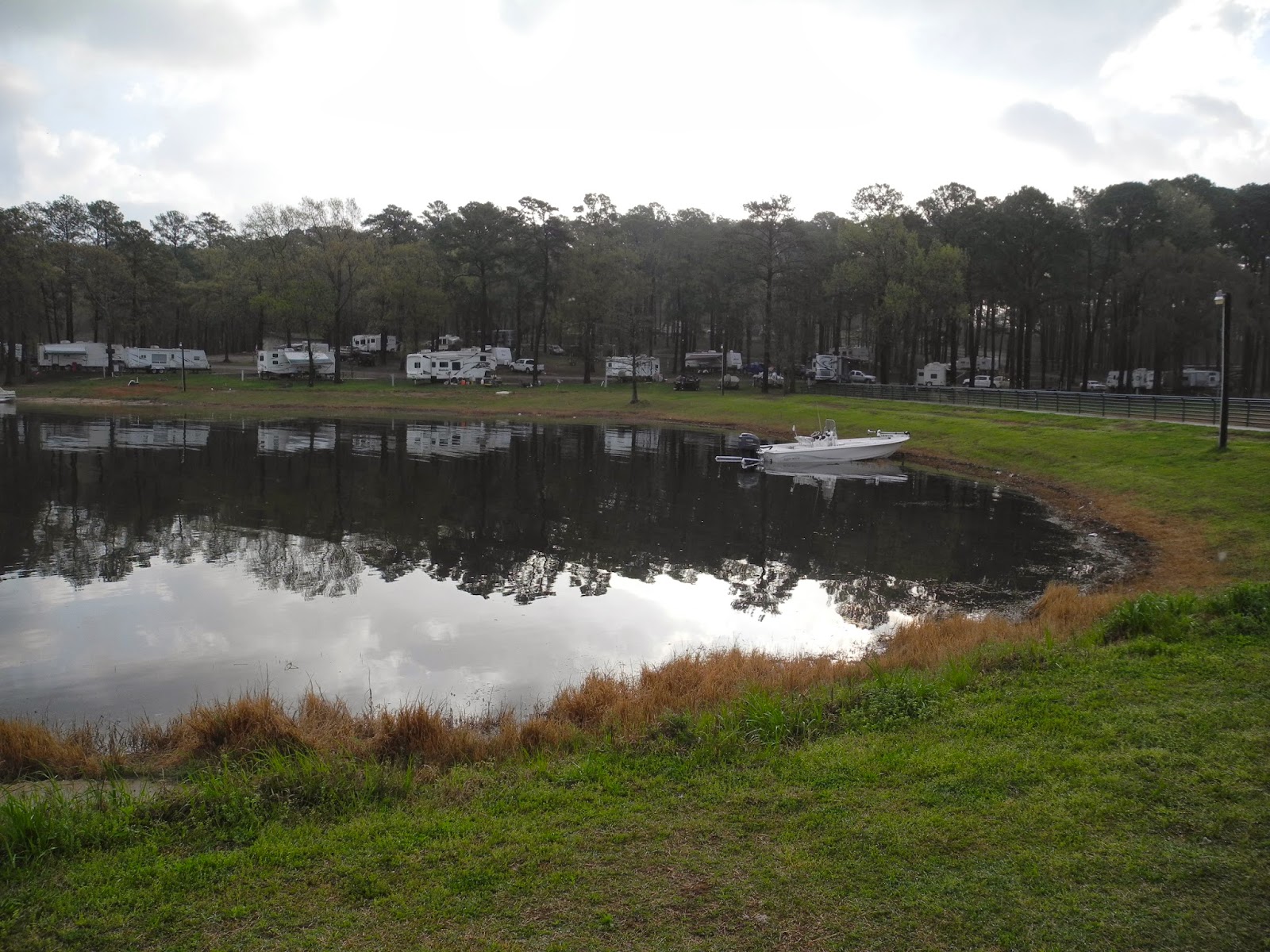
While at Wally World I finally got a “compass” so I can estimate distances better on our maps and campground guides. Because of the rain we didn't get much in the way of photos, but here's a couple I took the next morning when the rain had cleared up some.