Sunday, September 25, 2011

Mark Twain and the Wonderful State of Missouri


Right now we're holed up on the edge of a packed truck stop in a little berg called Cameron, Missouri. We were headed for a state park down the pike a bit from here, but when the grocery clerk from whom we'd been buying supplies told us that a RV park of sorts could be found right here in Cameron we decided to save ourselves the drive and get dinner on the table sooner.

Oh, this place has all the required amenities mind you -- water, sewer, electricity. And it's far enough away from the truck parking to be quiet, maybe even too quiet. No, the only problem with our "home" for the night is that it reminds us of what you might find if you had explored behind the Bates Motel and found an RV park there.

The "park" consists of a patch of asphalt, most likely put down when Eisenhower was running for election, a half dozen desultory poles planted every twenty feet with just the barest remnants of white paint still adhering to them, and a whole lot of nothing else. No trees, no friendly patch of grass for people to "walk" their pets. Not even a rusty old barbecue pit, most often made from a converted truck wheel.

To the white-ish poles are attached the electrical boxes providing our 30 Amp service, themselves looking like they had been pulled together from a dozen different sojourns to the Sunday afternoon flea market. Beneath the poles, amongst the disintegrating chunks of tarmac and rangy weeds gaining a toehold, are the required sewer outlets caped by a PVC lid growing ever more yellow in the sun.
Our water is provided by an ancient freeze-proof, lift-up faucet, canted at a 15 degree angle from being backed into a few times. It's so old and rusty that it steady leaks from the top seal so much water that I suppose the camp owners will actually lose money on our stay.

But hey, we had such a wonderful day today that I'm just going to overlook the less than wonderful camp conditions tonight and just tell you about our day, one that started out in one of the most beautiful campsites in all of Missouri, tucked as it was into a mountain glen literally choked with trees, where we spent the most peaceful night of this whole trip with not a single sound to disturb our slumber.
Today we had toyed with the idea of doing a host of different activities but we finally decided to visit the town of Hannibal and see what Mark Twain's boyhood stomping grounds had to offer. We gave ourselves a tentative time limit of the morning hours before lunch and set off from the middle of town on a grand adventure back to the year 1835 when Sam Clemens was born. Sam was not born in Hannibal, but in an even more obscure town of Florida, Missouri. But from the time he was four he lived in Hannibal.

Hannibal nowadays has a population of just 17,000 or so. I think I read somewhere that it was really an up and comer back in the riverboat days situated, as it was, just a sixty or seventy miles north of St. Louis. Today it's a much quieter place. In fact, if Twain hadn't lived there I suspect that Hannibal would exist only in the history books today. Nearly every business in town tries, with obvious varying degrees of success, to springboard off Twain's fame to make money on everything from antiques to cheeseburgers.

Still, Hannibal looks charming from a distance and we found the inhabitants to be just that. Everywhere we went on our "history walk" people were friendly and outgoing and eager to provide us with whatever information we required, even if they didn't stand to benefit. Our intent initially was to find the Clemens family home and see what we could see. But the clever museum folks of Hannibal don't let you breeze in and out so quickly. Once you check in at the information center and pay your $7.50 (seniors, you know) you are given tickets and started on a historical journey that takes a couple of hours or more to complete and marches you through Sam Clemens' entire life, from boyhood to manhood.

A lot of times when you're museum addicts, as best describes Concetta and me, you end up experiencing a multitude of efforts in that realm. Some museums are too cursory. Some are overwhelming. I tend to like a light touch since I easily get bored when I try to read little cue cards on 11,000 different exhibits. In Hannibal, we thought that the museum folks have done an outstanding job on their museum experience, both at the information center where you start your tour and, later, at the more formal museum two blocks south. As you wend your way from information center to the Huck Finn house, to the Clemens house, to the infamous whitewashed fence, and on to the two-story main museum, you discover that all the exhibits are presented with a minimum of verbiage and a maximum of visuals. Life-sized photos and cutouts of Clemens are often utilized to present the viewer with excerpts from his various published works, speeches, and letters. We just thought the whole effect was terrific.

So, there you have it. If you're a Twain fan and you haven't been to Hannibal, we'd encourage you to go. There's lots more to do in the area than we did, but you'd have to plan on staying a bit. And if I were you, before you go, I'd pick up that battered copy of Huck Finn or Tom Sawyer from your bottom shelf and re-read those magic words. It will make the whole thing come alive for you.

Personally, I've been a Twain fan since the seventh grade when I used to prop one of his books of short stories inside my text book while in Spanish class and spend the whole period lost in Twain's world. I didn't learn Spanish all that well, but I did discover a love of good writing that has never waned.

After our morning with Mark Twain and our lunch in the parking lot of a deserted auto garage, we cranked up and headed out. After checking our directions with the gas station attendant where we topped off the tank, we set our course for Highway 36 that runs from border to border across the states of Missouri and Kansas and then plunges right on into Colorado. Our goal for today was to get as close to St. Joseph, Missouri as possible. The town of Cameron, a few miles to the east of St. Joseph, was just the only town in our guide book that listed a camp site.

And here we are. Outside the window the night is descending. Atop one of the scraggly power poles a "night light" just snapped on providing us with a pool of soft illumination to keep us company. Fortunately, we don't have a bedroom window which faces that direction, so it shouldn't keep us awake.

As she has done for the past several days since the rain stopped in Ohio, mother nature has provided us with spectacular displays of pastel skies all day. I've included a photo of one vista where we stopped to use the phone. The country through which we've been traveling since we left Hannibal is achingly beautiful, with tiny farm houses, red barns, and meandering streams dotting the landscape amidst hundreds of acres of waning crops. If I stopped everywhere I saw a prize-winning photo waiting, I'd never get anywhere.

Tomorrow? Well, I'd like to see what St. Joseph offers to commemorate its place in the American biography since it was the best-known "jumping off place" for wagon trains leaving for the gold fields of California and the verdant farming country of Oregon.

Until then, we wish you good food, good wine, and exiting destinations.

Ciao.

Saturday, September 24, 2011

Headed for Mark Twain's Home Town


This morning, after the obligatory fuel stop, we jumped on Illinois I255 and headed north to the site of the ancient Native American city of Cahokia. Since we chose our camp site last night based on its proximity to Cahokia, it only took us fifteen or twenty minutes to find it. We pulled into the parking lot hoping, as we always do, that there wouldn't be so many cars in the way that we'd have a problem locating enough space for the motor home.

But we had at least half the parking lot all to ourselves and chose a nice spot beneath a spreading maple full of fall colors. Our plan was to spend lunchtime in the RV in the shade of that tree before we headed north and west to our final destination for the day, Hannibal, Missouri.

Let me just say that Cahokia is immense. How big? Try 2200 acres. Naturally, we didn't intend to prowl the whole property, but we fully intended to do some walking so we disembarked from the coach with our day pack, water bottles, camera, and suitable hats intending to spend at least several hours pursuing one of Concetta's favorite subjects, that of paleo-Indians.

Just inside the door of the interpretive center we were invited to view a 17 minute film that would acquaint us with the site and make our visit more rewarding. After the film we spent the next two hours trying to absorb as much as possible of what life was like in the Mississippi River valley between 700 and 1400 A.D. Unbelievably, this civilization, at its peak about a thousand years ago, counted as many as 20,000 citizens, the largest city north of the Aztec's Mexico City. Not until Philadelphia of the 1830s did North America have a city as large.

Now paleo-Indian cultures are not normally my favorite subjects of study. But these people were so industrious I was enthralled. If you've Googled the subject you know that the specialty of these early Mississippian Americans was digging large holes near their villages and putting the dirt in a central location. The biggest mound, which Concetta and I climbed, took 300 years and no less than 15 million trips to the top with a 50 to 60 pound basket of dirt to complete. Try getting your teenagers to take on a project like that.

Once up there, you could see why the rulers wanted to put their central government houses on top of these giant mounds. There's no doubt who's in charge when you have to look skyward to see your head guy. One sign I saw said that the chief's "hut" was about 50 feet by 100 feet in size. Can you imagine how much time, effort, and materials went into such a project? It wasn't the pyramids of Giza, but it sure must have taken as much coordination to pull off.

My favorite part of the museum involved the process called "flint-napping." Flint-napping is chipping away chert material to get things like arrowheads, spear points, hoes, war clubs, and scrapers. I always get lost in watching somebody do that. Using things like bones and antlers, these Indians patiently (I don't normally have a lot of that) flake off one bit of chert at a time until they finish with a splendidly crafted point. Beats me how they're able to do such a fine job though I've watched it done numerous times. I watched the video at the museum twice, but I think I'd still need some hands on to ever try it myself.

This particular civilization did not fail because of the coming of the Europeans. Amazingly enough, Cahokia had ceased to exist around 1400 A.D., before even the Spanish had begun their explorations of the new world. What did them in? It was their Success! The civilization's farming techniques were so successful that it encouraged a population explosion. One statistic we saw recounted that Cahokia had 4,000 persons per square mile at the height of their civilization. Nowadays, we here in America believe that a population density of 250 persons per square mile is about tops for an urban setting. Even though they were experts in growing corn, squash, beans, and a variety of salad greens, 20,000 humans is a lot of people to feed on a daily basis. They were also adept at foraging for natural foodstuffs like nuts, berries, and root tubers, as well as the usual compliment of native animals and fish.

Experts think that their success at nation building may have caused their ultimate failure. Too much food needed. Too many trees burned for firewood. Too little sanitation for a population that size. Any one or all of these things may have ultimately caused these early Americans to move away from Cahokia and allow the city to die. Whatever the reason, they left behind some truly fascinating clues to what life was like in their time. Concetta and I very much recommend you try and see it when next you travel this way.

When we rolled out of Cahokia I told Concetta that our next destination, Hannibal, Missouri, ought to be a piece of cake. As Billy Crystal would say, "Never say famous last words." All we had to do was jump back on Interstate 255 north, change almost immediately to Interstate 70 west, and, when the opportunity arose, catch state route 79 north to Hannibal. At least, that's what it said in the playbook. And at first things went well. We found I255. We exited promptly onto I70. But then we started getting hit with all manner of choices of freeways coming in rapid fire one after the other. Before we knew it we were blazing through St. Louis, trying to keep our eyes on the road while the St. Louis arch, in all it's early afternoon resplendent glory, beckoned out our passenger-side window. But we trucked on hoping that at some point we'd see a sign for state route 79 and we could get off the Mad Hatter's Tea Party of St. Louis' freeway megalopolis. On we trekked without seeing it when I was just certain we'd way overshot our mark and we're going to end up somewhere in central Missouri, hundreds of miles from our intended destination. Meanwhile, I'm yelling at Concetta to find our location on the map and tell me where in the hell we were.

Well, long story short, I finally exited the freeway and found myself an abandoned gas station to rest and consult the map before I had a meltdown. Naturally, it only took seconds to see if I'd just stayed on the I70 where I had been, my turnoff was just a mile or two further along. Yup, it was a tad hair-raising, but in the end we found our route and were headed north along the "Scenic River Route" on the west bank of the Mississippi.

Then, for the next sixty or seventy miles, things were wonderful. The sky over Illinois and eastern Missouri was more beautiful today than we've seen it anywhere for the past month. The randomly-spaced clouds were ultra fluffy looking, the sky's hues were all pastels of blues and purples and reds, and the overall effect was like an oil painting. It was something to see. Concetta and I rolled along, listening to our book on tape, and just let the Tioga eat up the miles.

And then Billy Crystal intervened again, darn him. There we were, out in the middle of who knows where on this twisty, curvy, mountainous road, when we rounded a corner and found a big orange sign blocking the entire highway. I looked at Concetta and back at the big orange sign. It said, simply, "Road Closed." That's it. No other information. No, "gee, sorry traveler, but an atomic bomb exploded just ahead and you'll have to go back to St. Louis until we clean it up." Or, "go back pilgrim, urban terrorists have taken over Hannibal and you don't EVEN want to go there now." No, it just said, "Road Closed" and let us decide what course of action to pursue.

Off to our right was this lonely-looking dirt road that crested a nearby hill and disappeared into the surrounding croplands. Well, we certainly didn't want to go THERE. But, we didn't want to go back either. So, finally, we backed up, put her in gear, and rolled into what we fully expected to be a future episode of the Twilight Zone.

Naturally, the entry of this thirty-foot behemoth onto this damn wash-boarded, dusty road did nothing for the RV or any of its rather loose-knit contents. Things were rattling and banging and, we felt certain, tearing themselves loose from their chintzy moorings and scattering themselves across the floor. Dust began to fill the coach immediately. Thankfully, turning the air conditioner to full blast cut the dust a bit.

Presently we came to a "Detour Sign." "Wow," I said to Concetta. "That would have been usefull out on the highway." But before long more detour signs began to show themselves, almost as if they'd been tacked up as an afterthought. They were faded and dog-eared and sad looking. It appeared to me as though no one really cared if you figured out how to choose the proper set of roads amongst all the different fields full of dead corn stalks or not. If you got lost, they'd just establish a cargo cult of some sort and strip your errant rig of whatever valuables they could turn up.

After about fifteen minutes we got to a "T" intersection containing no signs at all. One road went left, one right. We finally decided that left was sort of in the direction we had been traveling out on the highway and turned that way. Soon, we reached one of the sad, faded detour signs confirming our choice and minutes after that, the highway. Once we reached the camp grounds the manager told me that the road had been torn up for TWO YEARS! Now that's progress.

So, here we are, just a stone's throw from Mark Twain's boyhood home (he was born elsewhere you know). Fortunately, this is the one time that I called ahead to secure a spot in a camp. Every other night we've taken pot luck and made out just fine. But something told me that Hannibal's only campground was going to be above-average in popularity. My hunch proved right. When we got here we found that several travel clubs, made up of people driving those $100,000 bus-sized coaches, had made reservations, too. We got one of the few remaining spots.

At this point we're not sure just what activities we'll pursue tomorrow. We do know that by tomorrow afternoon we'll be headed toward the town that many of our ancestors in their covered wagons considered the "jumping off place" for the trails to California and Oregon, St. Joseph, Missouri. I expect there's going to be lots and lots of history to be found along the way. Until then, we wish you good food, good wine, and, above all, exciting destinations.

Ciao.

Friday, September 23, 2011

Middle America Muses


Today, with the sky looking like rain and the weatherman reporting more of the same, we broke camp in Terre Haute and headed west on Highway 40, the National Road, first proposed to the U.S. Congress by President Thomas Jefferson. Our destination for the day was East St. Louis, somewhere near the town of Cahokia. Our goal was to visit the ancient Indian mound site of Cahokia wherein lie the ruins of the largest prehistoric city north of the Aztec city of Mexico. The area is also a United Nations World Heritage site.

For now, we’re sitting in an absolutely “sold out” camp site where we only got a space because a particular camper’s reservation has them showing up tomorrow after we’ve left and no one else before us wanted a single night’s stay. After so many nearly empty camps as we head into fall, finding one this popular was a surprise – well it was until my next door neighbor mentioned that he’s here for the ball game. Not sure which ball game since I don’t follow such things, but we feel very lucky that we got here at 3:00 p.m. and decided not to visit the Indian site this afternoon. Had we come later, well, we’d have been in a tough spot.


Anyway, the drive here this afternoon was just a joy. Highway 40 is a 1950s, pre-Interstate sort of road with one lane in each direction. You run with your lights on to avoid collisions and, most importantly, you take it easy. I drive between fifty or fifty-five and keep my eyes peeled for interesting photo opportunities, though most of what you see is gently rolling hillocks full of dried corn stalks and yellowing soy bean plants. The whole landscape is like a soft watercolor painting with only the occasional bright red or green tractor or dazzlingly white farmhouse to break the sweep of the fall colors that flow uninterrupted toward the cornflower blue of the sky on the distant horizon.

The gentle pace is far easier on the engine, probably gets us a mile or two extra in fuel consumption, and serves to lower my blood pressure immeasurably since we’re out on the Interstate not being blown around by 18-wheelers flying past.

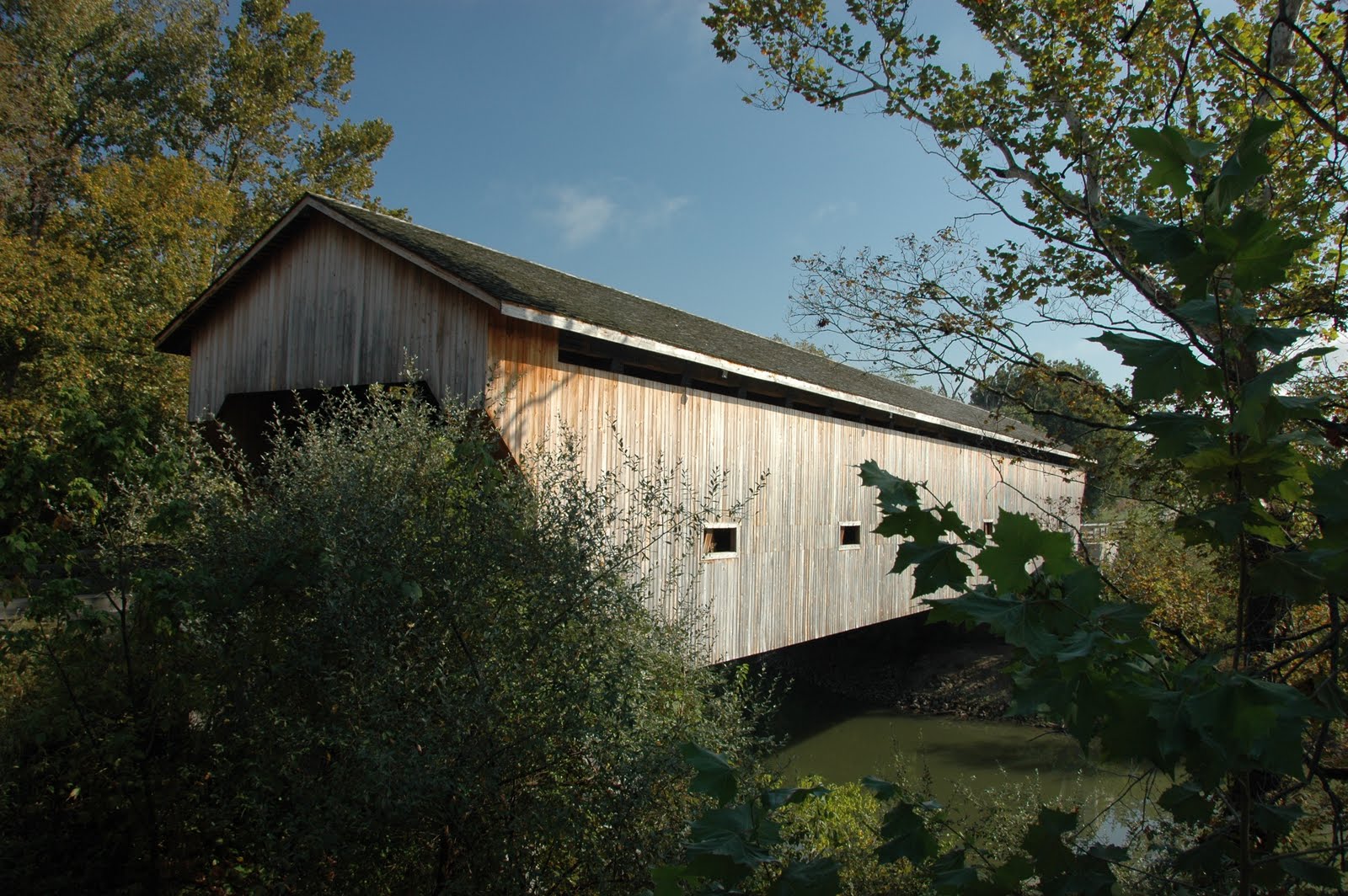
Our journey didn’t involve much stopping today. Oh, we passed a myriad of antiques stores in which I would have loved to spend an hour. But I don’t really have much room to haul any extra “cargo” so I have thus far avoided the temptation to stop and explore. Perhaps our favorite stop was for the Cumberland County covered bridge, which, though it was a reconstruction of the original bridge, was a fully working replica that serves to carry traffic, though not for the main road. Probably all of you have explored a covered bridge in your life and know that few things are as quaint and wonderful as these timber-framed gems.

We chanced upon the perfect lunch spot today nestled at the edge of a farmer’s field full of soy beans, bordered by a white rail fence. The sun was behind us and the view across the golden yellow field filled us with awe that we could be privy to so much beauty.

The most entertaining stop today was for groceries. Some of the grocery stores we’ve chanced upon on this trip rival, and sometimes surpass, the finest stores we’ve visited anywhere. However today the store was right out of Mayberry, RFD. Concetta and I had been pretty successful in finding all the items on our list until we got to the last two which we decided to split. I took the vitamins and Concetta took the dried dates. Since I had no firm layout of the store memorized even though we had already wandered throughout much of it, I began at the first aisle and began to walk up and down each one. Finally, when I had found no vitamins, I headed for the nearest check stand to verify that I had just been unobservant and would need to retrace my steps. When I presented my question to the tall, slender woman behind the register she looked at me for a long moment. Figuring that she was just trying to decipher my accent, I repeated, “Do you happen to know on what aisle I might find the vitamins?”

With that she said, “If we have any, they’ll be on aisle seven.”

I turned and looked back down the long aisle that I had so recently thoroughly explored. No sense going back there. What kind of grocery store doesn’t have vitamins I wondered? I looked back at her. “Okay, thanks,” I said, and headed off to see how Concetta had done on her quest for dates. Good thing I wasn’t looking for Tai food or Greek yogurt or something like that, I thought.

When I reached Concetta, I said, “Well, did you find the dates?”

She shook her head. “When I asked one of the clerks where the dates were located the woman just looked at me like I was speaking a foreign language. I told her, you know, DATES.”

“And she didn’t understand?” I asked.

“Nope. Told me she didn’t know what I was talking about.”

“You should have described the palm trees they grow on. She might have seen pictures somewhere.”

Concetta just shrugged. “I think the woman thought I was crazy.”

We did try a little date sleuthing on our own since, on sudden inspiration, I figured they’d be kept wherever the raisins and dried fruit were kept. But alas, when we located the raisins they didn’t prove to be keeping company with the dates. Personally, I love dates in my oatmeal so, if asked, I’ll have to inform the good citizens of Vandalia, Illinois, that I won’t be moving there anytime soon.

Tomorrow? Well, after our communion with the ghosts of all those long-dead native Americans, we're headed northwest toward yet another of our bucket list destinations: Hannibal, Missouri. There's talk of exploring "Injun Joe's" cave or maybe taking a stern-wheeler ride on the Mississippi. Mark Twain is calling and we can't wait to answer!!!

Until then, we wish you good food, good wine, and, above all, exciting travel!

Ciao.

Thursday, September 22, 2011

Exploring Indianapolis in 1836


Today we decided to do a little exploring around Indianapolis before we resumed our journey west. From the KOA map that the camp hosts gave us last night when we arrived, we discovered that just a few miles north of our location on I70 was something identified as "Conner Prairie." From what we could tell, Conner Prairie was a largely outdoor interactive museum where various aspects of life in the 1800s are portrayed by museum docents.

It didn't take long for us to discover that this was going to be a museum trip unlike anything we'd experienced before. From our very first activity where I was invited to throw a Delaware Indian tomahawk at a slice of tree trunk thirty feet away (sorry, no photo of me), to our final experience nearly three hours later where we were invited to join the Union army to fight the rebs, we were totally immersed in the history of Indiana of nearly two centuries ago. Just as an aside, I was the only one in the group who buried the tomahawk in the tree. Of course, my competitors were in the sixty grade, but hey, they're more used to throwing things than I am.

Naturally, Concetta and I did not originally intend to spend nearly the whole day at Conner Prairie, but once we began wandering in and out of all the various commercial and agricultural buildings we just couldn't bear to tear ourselves away. All the docents played their parts wonderfully, remained in character, and taught us a lot about a dozen different vocations.

Just to be a smart ass, I even tested the blacksmith to see if he was a real blacksmith or just someone banging on an anvil with a big heavy hammer. I pointed to a special tool hanging on the wall, a copy of which I have in my collection, and said to the young blacksmith, "So, do you know what that tool is?"

"Yes, of course," he said. "That's a Traveler."

He was right, it WAS a Traveler which not one person in a thousand would know about today. The tool was used to measure the circumference of a wagon wheel so that a metal "tire" could be cut to the right length, welded together, and placed over the wooden wheel to hold the whole thing together and insulate the wood from the rocky roads. Looking much like a modern accident-scene wheel device on a handle, the Traveler would be rolled around the wooden wheel establishing a measurement, then rolled along a flat piece of iron for an identical number of revolutions. The iron would then be cut at the appropriate point.

Early wheelwrights would put the completed iron tire on a large fire until it heated enough to expand. Then several people would pick up the red-hot tire with tongs, carry it over to where the wooden wheel was laying on the ground, and then drop the tire over the wheel. Of course the red-hot tire would immediately set the wooden wheel on fire. But when the wheelwright would dump buckets of water on the wheel it would not only put the fire out but shrink the iron tire, causing it to grip the wooden wheel in a vice-like embrace. Absolutely fascinating to watch if you ever get the chance.

So, the blacksmith proved his mettle and put me in my place. All the other docents proved equally knowledgeable. I especially liked the dying and spinning cottage where the process of cloth manufacturing was thoroughly explained to us. They had dozens of different colors they had used to dye the wool made from a huge variety of natural plant extracts. At least most of them were plant extracts. The one that fascinated me the most was the tiny parasitic insect that is found only on the prickly pear cactus that, when harvested, yields a bright red dye. They told us that folks in the Old World were very, very excited about the discovery of this little bug since until that time they couldn't have cloth in brilliant red.

I watched the woman running the loom for a time and learned a lot about that discipline. In the past I thought that you just moved the warp threads up or down after each pass of the weft thread on the shuttle. In reality, you have a number of warp pedals (this particular docent's loom had four) and you hit them in combination to open up a specific color combination for passing a specific color of weft. This allows for patterns in the cloth. The final product is called the "weave." Our ancestors were so darn inventive it just astounds me.

We learned about wood working and the preparation of logs for cabins. We learned about trapping and hide preparation for sale and trade. We learned about Irish stitching (a sort of needlepoint). We learned about doctors and the concocting of medicine in a small rural community. We learned about so many things that I probably should have recorded it all. The time went by so fast that 2:00 p.m. came and went and we suddenly realized that we had simply forgotten about lunch. We had to tear ourselves away and go find a quick sandwich and cup of coffee.

Finally, as the sun (or what we could see of it through the rain clouds) sank lower in the sky we decided that we just had to get on the road or we'd have to return to our previous KOA camp and stay the night again. So it was that we left Conner Prairie, found Highway 40, and headed west toward Terre Haute, Indiana. We're not sure what opportunities lie in wait for us here in Terre Haute, but our next big destination is the Cahokia Indian mounds near St. Louis. So if nothing distracts us in the morning, we'll be rolling toward the city that has been know since the emigrant wagon train days as "The Gateway to the West."

Until then, we wish you good food, good wine, and good traveling. Ciao.

Wednesday, September 21, 2011

Rollin' on toward Indianapolis


This morning, under the rainy skies of Ohio, Collin delivered me to the Moose Lodge where we had been parking the motor home for five dollars a day. Just ahead of a rain shower I disconnected the electric line and brought the coach back to sister-in-law, Phyllis' house where we loaded up our stuff, including clean laundry, and headed once again for the open road. We were trying to beat the rush hour traffic in Akron so we were rolling by 6:30 a.m., though yours truly had not had his breakfast or coffee yet.

Around 8:00 a.m. we spied a Bob Evans restaurant that looked interesting and, since the parking lot was fairly empty, I drove in and took up my usual eight parking spaces. I can't say the coffee was anything to write home about, but the breakfast was hot and the service great. Also on the plus side, our waitress saw that we had brought our Atlas in to lay out our route for the day and she proceeded to carry on a lively conversation with us about traveling and how her parents had just spent 3 1/2 months on a motor home tour that extended all the way to Alaska.

My first task of the day was to figure out how to fix the tail light on the RV that had suddenly decided to quit working. So it was that when we veered off route 77 south and started west on Route 36 I came across a Walley World and drove back to the service area to see if they might have the necessary part. The two twenty-something mechanics just scratched their heads when I showed them what I wanted and told me that they didn't have any such part. Of course my heart sank at that point since it looked like I might spend the rest of the morning trying to find a taillight for a 1996 Ford RV. "But," they quickly added, "just drive out the rear of the parking lot here, take a right, and go down a couple of blocks and you'll see a bus and truck repair place. Maybe they have one."

Not holding out much hope that a bus and truck repair place was going to do me any good, I nevertheless thanked them and set off to seek what I just knew was going to be the first in a long line of fix-it shops that I'd have to visit on our quest.

Moments later we pulled up in front of the repair shop and I walked over to where I saw a mechanic working on, of all things, a motor home. Of course, by then I had removed the old light and was holding it in my hand. When I got the mechanic's attention I held out my taillight and said, "I don't suppose you guys sell this model of light."

"Sure," the mechanic said. "Just go over to the Parts Department window and they'll fix you right up."

Scarcely able to believe it might be true, I set out for the aforementioned window and, when I got the attention of the chap behind the counter, I dangled my scruffy taillight in front of me and asked if he happened to have one.

"Sure do," he said. How many do you want?"

"I'll take two," I said, for I knew if both taillights were the same age they might just decide to burn out around the same time. The ol' bird was in the hand and the next time I needed one I just wanted to go to the storage locker to pull one out.

So the task that had promised to take most of the morning was completed in under an hour and we were back on the road. Since we were traveling on secondary roads, our scenery was beautiful. And even though the Ohio skies were overcast and gloomy we had our book on tape to pass the driving time. That's the good news.

The bad news is that the last two books to which we've been listening on the CD player have been by Stuart Woods, an author that obviously has no trouble getting into print, but an author that I personally wish had taken up bicycle repair or taxidermy or something instead of writing. His stories are just plain unbelievable and dull. He tries to spice up the plot with equally unbelievable sex scenes. And -- this is the worst part -- the guy who narrates these particular books should have found another line of work as well. His speaking voice is sing-songy and stupid-sounding. His ability to do different voices for different characters is nil. And his ethnic character voices are just downright insulting. Finally, all the women sound like men and all the men sound like wimps. Most of the time you hope that characters hurry up and get killed so you don't have to listen to them anymore.

Concetta insisted that we finish both books since we'd paid good money for them. Left up to me I'd have donated them to some unsuspecting library book return box and bid them a not so fond farewell. Fortunately, since I received a lot of books in trade from my buddy John we now have a fresh supply for the balance of the trip.

Today we made it to Indianapolis and we're staying in a KOA just east of town. Outside, the evening is so pleasant that we ate on the picnic table on the lawn outside the coach. Amazingly, we weren't bothered by bugs at all. For the time being we seem to have put the rain behind us.

In the morning we're headed a few miles north to take in a outdoor museum before we decide in which direction to drive. Concetta doesn't really want to go straight west which I suppose would take us through the cornfields of Nebraska and such. So the subject is still under discussion. What's happened in the past is that we'll run into someone tomorrow who will recommend a particular destination and that will decide the question. You know how I love serendipity.

Until tomorrow, then, I bid you good food, good wine, and best of all, good traveling.

Tuesday, September 20, 2011

A Chance Encounter


As most of you can tell by the absence of blog entries, Concetta and I have been spending several days with our relatives in Akron, Ohio. Mostly what we've been doing, if you want to know, has been eating. We just move from one house to another, one meal to another. In between we just visit and hang out. Consequently, there hasn't been much in the way of adventure going on that I could tell you about.

But two days ago I got a phone call from my buddy John telling me that he and his 70,000 pounds of "pot stickers" were going to be hanging out at a truck stop just a few miles north of Akron for the night and did I want to come up and, what else, have lunch or dinner? (John had been following our progress via our blog) John's a long-haul trucker for a Texas company and just happened to be hauling a load through our immediate area. Well, I jumped at the chance since I hadn't seen John in quite some time.

Fortunately, it was only lightly raining as I hiked the half mile to the Moose Lodge where we're storing the motor home and soon I was headed up I76 to where it joins with I80 north of Akron. I had a little trouble finding the truck stop and the rain changed from drizzle to full on showers, but everything went fine and soon I was parked next door to the truck stop.

Since I didn't know exactly when John was going to arrive, I fired up the motor home's generator, plugged in the computer, and was busily reading email when John called to tell me he had arrived. A few minutes later we had made our rendezvous and were headed south on route 21 for the nearest bistro for a little lunch. We soon found a really great sandwich shop called Brielle's on the west side of the street and spent the rainy afternoon catching up, eating some outstanding potato salad, and drinking hot tea.

Once back at John's truck, we traded our small supply of books on CD, visited some more, then I headed back down the road to Akron as the rain beat enthusiastically on the RV's roof. It had been great seeing John and an amazing coincidence that in all the U.S. our paths would cross here in Concetta's home town.

John and I go back to the 7th grade in Altadena, California, where we grew up in the foothills of the San Gabriel Mountains, spent much of junior high and high school days together, then spent a year aboard a sixty-foot yacht in the Mediterranean working as both boat crew and film crew for a filmmaker shooting a documentary.

Now John is on a different adventure, one that I hope will eventually turn into a book about trucking. He's a talented writer and if anyone can do it, I'm confident he can. If you're interested in reading about John's adventures on the road, type www.roadquill.wordpress.com into your browser and check him out.

Friday, September 16, 2011

Long Day in the Windy City


If you missed the blog yesterday it's because we didn't get back into camp until after 10:00 p.m. last night and we were too tired to try and think creatively, especially after doing battle with Chicago's maze of freeways and torn-up city streets for four hours, two going and two coming back. We were staying in the tiny hamlet of Union which is located, according to MapQuest, about seventy miles to the northwest of Chicago along route I90.

The first part of the day started out very pleasantly as the Illinois State Railway Museum is just three miles down the road from our camp. When I say that this place is a museum you should immediately banish the notion that this thing is in any way museum-like. It's more like an operating railroad yard full of trains that just happens to be owned by a non-profit organization. There are trains EVERYWHERE!

In addition to perhaps more than a half dozen giant warehouses full of the best equipment, they have dozens of cars and engines stored outside around their close to fifty acres of property. The only disappointing part of our visit was that most of the warehouses were locked and we were only able to tour one. But what we saw in that one warehouse, as well as around the rest of the grounds, was very impressive not to mention photogenic.

At IRM they have everything from steam engines to old-time trolley cars, from immaculate passenger cars from the 1940s to freight cars from the turn of the last century. They even have old Chicago "L" cars parked next to a subway platform, just ready for boarding. We would definitely like to come back someday when the museum is in full operation and take in more of the sights

After an hour or so of touring the Rail museum, we loaded up and headed for the "Windy City." Both of us had been dreading the thought of taking our thirty-foot home on wheels into the heart of Chicago all the way to the lake shore. We knew that it was not going to be a particularly pleasant experience. Actually, it didn't turn out to be too bad. The GPS more or less led us right to the spot we needed to park. Only once did it send us on a wild goose chase and we nipped that side trip in the bud, reprogrammed, and began again.

One thing you have to realize about Chicago is that they absolutely love to tear up their streets and, knowing that those already overloaded streets are vital to the sane flow of traffic during peak hours, will leave them torn up for literally years at a time. When I lived on the north side of Chicago back in the early 1970s I more than once watched the highway guys tear up a block-long stretch of road near the air base where I was stationed and milk that project for the next year. They proceeded at such a snail's pace that you just permanently rerouted around that stretch knowing that in your lifetime you might not see it finished.

As you might guess, our trip to Chicago was undertaken along with what appeared to be several million others all headed downtown. As I said, I lived in Chicago before, for some three years, so I knew pretty much what to expect. I knew that the freeways would be packed, the city streets narrow, and there would be lots and lots of construction with which to contend. It turned out that I was right about all three. At places we would be funneled from two lanes down to one, forming a bottleneck, which, when you're trying to merge a thirty-foot vehicle, is sort of like trying to commute in a moving van. Amazingly, in under two hours we actually made it to the shore of Lake Michigan. I did have to stop at one point and ask for directions of a security officer, but by then we were so close the officer told us to just turn left where we had lately turned right, go two or three stop signs, and we'd see the parking lot.

The parking lot was so spacious and so empty we could have been leading a whole convoy of motor homes and they all would have found parking. A little pricey at $32.00 but we were only a ten minute walk from the Field Museum, the Shed Aquarium, and the Planetarium. It couldn't have been more perfect. The other thing that was perfect was the crystal-clear day that Chicago had conjured up, I'm sure, just for us.

I actually had trouble walking the short distance to the museum because I couldn't stop taking photos of all the brilliantly-lit buildings, the harbor full of creamy white boats, or the skyline of the city which lay a short distance to the north of where we were walking.

You may remember that our quarry in Chicago, at least for this trip, was the Field Museum where I wanted Concetta to see what is truly an outstanding collection of Egyptian mummies and other artifacts. Back in 1969, when I first found myself in Chicago for what appeared to be a long-term stay, I sought refuge from the demands of Navy life in the Field Museum. Back then, before Dr. Zahi Hawass had worked so hard to generate interest in Egyptian archeology, I usually had the Egyptian section to myself. I'd spend hours there studying the artifacts and enjoying the artistry of ancient Egypt. Even though my interest in Egyptology has cooled somewhat over the intervening years, Concetta is an avid fan of ancient archaeological subjects. I just knew she'd love the Field Museum.

Some of you are probably aware that the museum experience, probably all over the world, has become very interactive. Where in the past I would enter a room full of parallel rows of glass cases with the artifacts displayed in ordinary light, now the whole Egyptology experience goes on in an environment that closely approximates, I would suppose, the actual mood and lighting of a tomb. No longer a big open room, now you wend your way through tomb-like spaces surrounded with limestone blocks actually purchased from Egypt. The mummies and other artifacts are all hermetically sealed and kept in low light to preserve them from harmful heat and light. It's all pretty mysterious and solemn. The only problem we discovered is that the light in some displays is so low you can't read the cue cards, which somewhat detracts from the experience.

The other display area that we had time for was the one dealing with the habitation of the Americas by native peoples. Once again, the Field outdid themselves with their largely interactive displays. In one that I especially liked, you could touch pieces of broken pottery that had been fastened to a display board beneath a computer screen. The instructions were to touch the pieces in the correct order to put the broken pot back together bottom to top. Now if that doesn't capture the imagination of some budding grade school archaeologist, I don't know what would.

One of the collateral activities that we planned for Chicago was to meet our friends, Katherine and Bobby Royce, for dinner while we were in the city. We first met Katherine and Bobby while on our cruise last fall to Turkey and the Greek Islands. The four of us got along famously from the beginning and we took many meals together on the fantail of the cruise ship as it plied the ancient waters of the Mediterranean. When we parted we promised to look them up if ever we made it to Chicago. So it was that we set up a date and they picked us up near where we had parked the motor home and we celebrated the one year anniversary of our friendship by finding the nearest Greek restaurant and having a party, avowing once again that good wine, good food, and good friends are the best things in life.

Once the Royces had dropped us back in the parking lot on the Chicago lake shore we realized that time had really gotten away from us. Since we had purchased two days at the campground in Union we had to now wend our way back out of the city and back north 70 miles before we could sleep for the night. As it turned out, the trip out was more hairy than the trip in, mostly because when the sun goes down the street maintenance folks double their activities and we spent much time creeping along a few feet at a time before we were able to reach the interstate and really get rolling. When we finally arrived at some God forsaken hour, we just pulled into the space and collapsed into bed, too tired to set up any plumbing or electrical.

This morning, with gray skies above us, we once more set off toward Chicago, but this time we used secondary roads and skirted the main part of the city. I didn't do any photos today as the light was just too flat and boring. We were able to find some parts of the old Lincoln Highway -- America's first interstate, now mostly highway 30 in this area -- and cruise through countless tiny towns in Illinois and Indiana. Tomorrow we're hoping to make the final leap to Akron, Ohio, where we will be staying for a couple of days visiting Connie's sisters and other relatives.

As Concetta pointed out to me this evening, my penchant for merely wandering throughout the country, stopping at whatever towns and hamlets that look interesting, and having no actual plan, has caused us to be much later reaching Ohio than we originally planned. Hard to believe that we've been since August 28th on the road and at this rate we won't be home until Christmas. I think her point is that we will probably have to turn around now and head back. We very much want to visit Gettysburg and a few other historic sites, but it doesn't look like we're going to be seeing the east coast on this trip. Sigh!

Anyway, that's the story. I'd sure like it if these dreary skies would clear up and look like Nevada tomorrow, but we'll have to see. Until then, I bid you adieu and, whenever possible, good wine, good food, and good friends.

Ciao.

Wednesday, September 14, 2011

A Happy Surprise


When last we saw the Happy Wanderers they had tried unsuccessfully to locate fellow co-worker, George Aldrich's mother at her farm in rural Wisconsin. Not sure how they were going to connect with her, the Wanderers decided to locate a KOA for the night and puzzle out the problem in the morning.

Low and behold, we had only just thrown off the covers this morning and stumbled out to make the coffee when the phone rang. Who should be calling but Rachel, George's missing mom. It turned out that not only were we going to get to see her, but she was only minutes away from knocking on our door.

Just in time for breakfast, Rachel soon pulled up outside and we spent a very pleasant hour over oatmeal, homemade cranberry bread (courtesy Rachel), and some wonderfully strong Peet's coffee (George's favorite). We were thrilled to find out that Rachel was farming/ranching sixty acres in rural Wisconsin, just down the road from the cranberry bogs. We could see from the drive that she has ample room for gardening. I suspect she has just a half dozen acres cleared for the homestead. Most of the rest is in hardwood and softwood forest. Speaking of forests, Rachel even chops her own wood, which we saw neatly piled behind the house. A more pleasant setting you would never find.

Anyway, thanks again to Rachel for the visit, the cranberry bread, and for making possible some forty-four years ago our association with one George Aldrich, computer tech extraordinaire and good friend. And George, Concetta and I liked your mom immediately and extended our invitation to come visit us (and you) anytime she feels like it. The guest room has her name on it whenever she's in town.

The balance of the day the Wanderers spent listening to one FABULOUS book on tape by a favorite author, Jack Higgins, rolling down the road in the direction of Chicago, and enjoying the scenery. We stopped for a very pleasant lunch in a state park off I39 called Lake Kegonza. The day was rather overcast and the light not very good for taking photos so, unfortunately, no scenics today. But for your viewing pleasure I include a shot of Rachel's old-time Aermotor windmill. I just love those things and would love to have one on our property.

I hope the sun's shining tomorrow. Word has it that there's a railroad museum just down the road from where we're camped off I90 above Chicago. However, my main thrust tomorrow is to introduce Concetta to the Field Museum on Chicago's lakeshore so that's where the Wanderers are headed next.

Stay tuned.

Tuesday, September 13, 2011

Breathing a sigh of relief


This morning, literally holding our breath, we headed back to the tire company to have our last two tires mounted and installed on the truck. After spending five hours yesterday getting four tires installed we were really apprehensive about going back. We didn't want to spend our whole day there. As we motored down the freeway we chanced a call and told them that we'd be in their shop in the next ten minutes. The front man told us that the new tires had arrived from the distributor and Derek was as we spoke mounting the first of the tires on one of our new wheels.

Soon after, we pulled up in front of the store and the crew set to work right away. We got there at 10:30 a.m. and we were unbelievably done an hour later, including remounting the spare underneath the coach. So, we now have six new tires, two new wheels, and we still have our new spare that we started out with underneath. All the other tires and the wheel that ended up on the ground along the freeway yesterday went into the dumpster.

Before we left town, we stopped by the Ford dealer, conveniently located next door to the tire shop, to inquire about any recalls for our 1996 E350 Ford. One of the maintenance men at our camp last night, a very helpful and friendly chap named Brent, said that there might be a recall on the cruise control, which was reported to catch fire. It was nice to find out that such was not the case for our 1996 coach.

Once we were out of the Ford dealer we set our sights on heading on down the road into Wisconsin. It had taken us two days to accomplish it, but we were finally clearing out of Minnesota, not the luckiest state that we have encountered, at least for the pocketbook.

The rest of the day we rolled down the interstate moving southeast. At one time I tried getting off and driving route 12, a secondary road that promised to be more rural in nature. We found so many 18-wheelers clogging the interstate (Sorry John) that it was kinda unnerving in view of our recent luck with tires. But that particular stretch of route 12 was just as busy and had a million stop lights to boot. So, we got back on the interstate.


Our special quest today was to find George Aldrich's mother's house just off I94 in Wisconsin. Mrs Aldrich lives in a beautiful area, though somewhat perplexing to find unless you're paying really close attention. Still, we eventually found the homestead and spent a half hour waiting to see if Mrs Alrich would show up. When she didn't, we left a message and headed back for the interstate where we had seen a camp site called, "Jellystone." Pretty original, hey?

Anyway, we soon missed an important turn and ended up way south of our intended camp site. So, when we wandered into Tomah we went ahead and cranked the address of the nearest KOA into the GPS and, well, here we are in beautiful downtown Oakdale, just eating some fresh trout, watching Pawn Stars on TV, and enjoying the good life.

George's mother's home was located in a truly beautiful forested area of Wisconsin and the log cabin-style construction was terrific (see photos above).

On the way to George's mother's house we chanced to pass a nice display of a vintage steam locomotive and two passenger cars that I just had to stop and photograph. I know not many of you are railroad fans, but for those who are, enjoy!

Monday, September 12, 2011

Just a sittin' and and a grinin'


Sitting in the morning sun
we'll be sitting when the evening comes
Watching the trucks roll in
And we watch 'em roll away again

Yes we're sittin' in the service bay
Watching the day roll away
We're just sitting in the service bay
Wasting time

We left our home in Carson
Headed for an eastern stay
'Cause we had nothing to wait for
looked like everything was headed our way

[chorus]
Looks like all the tires are gonna change
Hope nothing still remains the same
We can't leave 'till they do what they have to do
So I guess we'll remain all day

Sittin' here resting our bones
And this boringness won't leave us alone
It's three thousand miles we roamed
Just to make this tire store our home

Yes we're sittin' in the service bay
Watching the day roll away
We're just sitting in the service bay
Wasting time

-------------------------------------------------------------------------------------

Yup, Otis Redding said it best. We're sitting in the tire store waiting and waiting and waiting while they turn a 60 minute job into an all-day affair. Of course we can't bitch too much. They did rescue us off the highway. Trouble is, we got back here at 2:00 p.m. It's now a quarter to five and they've finished precisely one tire. Not sure how anyone can move that slow, but Concetta and I are sitting in the waiting room -- thankfully air conditioned -- and wasting time.

Busted flat -- AGAIN!!!!


No one is going to believe this. I hardly believe it myself. This morning, first thing, we headed out to buy supplies and check on a recommended tire company to check on purchasing a new spare. After that, we intended to travel about a dozen miles away and purchase a new wheel on which to mount the spare for, as you remember from yesterday, the old wheel was the wrong one for this truck. On the way out of the tire company parking lot I told Concetta, "You know, I'm just going to replace both the front tires on this rig with new ones and use one of the front ones for a spare." Concetta thought that sounded like a good idea.

So, off we went, back into Minneapolis to find the wheel company. Passing the spot where we were broke down yesterday afternoon we headed west on I94 with a stiff side wind out of the south to keep us company. Something with as much surface mass as a motor home is understandably harder to keep on the highway when the wind is blowing so I didn't think anything of the fact that the truck was tracking a bit strange. Finally, however, I told Concetta that something didn't feel just right in the steering so I pulled over to the side of the freeway. At that point the tire on the right front wheel tore through the sidewall and "walked" right off the wheel. Sigh!


So, here we are, sitting beside the freeway, as millions of cars roar by a couple of feet away. Naturally, I called the tire guy to whom we had just been speaking and asked him to come rescue me. In return, I offered, to purchase a whole new set of tires for the rig from him. That deal was immediately struck, though he had to go a little afield to find two of the six since he didn't have them on hand.

Then I called the wheel company in Minneapolis and asked if they made house calls. "Not normally," was their response.

"Well," I said, "this is kind of an emergency."

After hearing my tale of woe, the wheel company agreed to send a wheel out to our rig parked on the shoulder of I94.

Soon after, the tire company kid arrived, removed the shredded tire from the right front and took it back to his shop. A half hour later they called and said that the wheel might get me back to their shop if they put a used tire on it, but it was bent enough to not be safe to put back in service. SIGH!

Soooooo, I called the wheel company back and asked if the delivery boy hadn't left with the first wheel, to please load up a second wheel because I was going to need two. This deal was also struck, though the the delivery guy was already a mile away from the shop at the time. The wheel people graciously offered to call him back to pick up the other wheel.

I'm not sure how this is all going to end. We're not stuck in Lodi again, but it feels darn close. Ironic that this coach came from Lodi, isn't it?

Sunday, September 11, 2011

The Flying Fickle Finger of Fate Falls Fast and Furious


Well, I guess our impeccable luck couldn't go on forever, Right? Coming out of Minneapolis we neatly blew out the inboard driver's side dualie, shredded it into a hundred different pieces, with a sound like we'd been hit with canon fire. Not satisfied with merely ruining a $150.00 tire, the errant rubber proceeded to thrash the aft locker full of sewer pipes and connections and trashed that, too. I (carefully) motored off the freeway at greatly reduced speed, flashers bleeping, and parked her beneath a convenient freeway overpass. After chocking the front wheels, I settled in with my phone to communicate with my (heretofore) trusty AAA card folks. They've never let me down before and have always responded cheerfully and, more important, swiftly to my emergencies.

Well, it appears as though they now intend to pay me back for all the cheerful service over the years. On the phone I got what can only be described as a complete idiot. You know the type. They ask you the same questions over and over again as if while sitting in the hot sun with a flat tire you'd be tempted to lie to them about where you are and what your problem is. Jeeze!

Anyway, in addition to being dense as a wheelbarrow full of sod, this woman proceeded to tell me that even though I am a "Plus" member at some $90.00 a year my card does not cover motor homes.

"What?" I said, I'm sure sounding incredulous. "When did you folks think you might let me in on that piece of news."

"Sorry, sir," she said, sounding bored. "Where did you say you were?"

"St Croix senic byway where it crosses I94," I said, perhaps for the fourth time.

"And what was your exit number?" she asked.

"Don't know," I said.

"Sir," she said, though I don't think sir was what she mentally was identifying me as, "I have 22,000 St Croix streets in the area."

I pulled the phone away from my ear and stared at it. Had I inadvertently called the local funny farm? "Let me get this straight," I said. "Just east of Minneapolis on I94 you have 22,000 references to the St. Croix scenic byway."

Silence. Then, "What is your milepost, sir?"

Anyway, the conversation went on like that with the AAA bimbo asking a succession of repetitious, inane questions until she finally said that she'd have someone call me. Somehow, while I was out cutting the metal strapping off the side of the wheel well that had probably peeled the tread off our tire, I got said call from somebody but missed it. When I saw the message, I called the number back and got AAA in -- where else -- northern California. Thankfully, this time the AAA lady was both intelligent and thorough and soon had a dispatcher for AAA call me. The dispatcher called the fixit shop and they called me back. By this time, of course, we'd been sitting for over an hour. The fixit shop said they'd be another 90 minutes. So, here we sit, trying to act composed, while we wait and see if anyone in Minneapolis knows where the St. Croix parkway is located.

We do have a couple of pluses to our credit, however. For the first time I tried using the generator, which is currently humming away pleasantly. The second thing is, I tried my buddy Tennessee Don's suggestion for getting my mobile network connection to function and -- good God! -- the darn thing works perfectly. Thanks to Tennessee Don for his sleuthing on my behalf.

As you would expect, we have no idea just when the tow truck chap might appear around the bend. We're just hoping he knows where to come. I was able to go to Mapquest and easily find the St. Croix Scenic Byway off of I94 and learned that our exit is 258. Makes you wonder what sort of dumb pills the first AAA lady might have been taking when she (keeping in mind she does this for a living) tried to find the street on her list of 22,000 other streets. I'm just sorry I failed to learn her actual name as I'd love to refer to her by name here in the blog. Ah, missed opportunities.

It's just short of 6:00 p.m. and the fixit chap just drove up in an official-looking truck and immediately set to work on changing the tire. He seem appreciative that I parked the rig under the underpass where it's cool instead of leaving it up on the freeway.

Brian, our rescuer, immediately set about pulling off the tires on the driver's side of the RV. That all went well enough. He also checked my discovery that the passenger side inside dualie was low on air. "This is your problem with the low tire," Brian said, and showed me a air filler tube that had been worn part way through. He removed the filler tube and was able to pump the tire back up. "Those filler tubes have to be watched closely," Brian continued because they move around a lot.

Okay, I thought, we're looking good here. I continued to think those thoughts right up until I heard Brian cuss and I went over to see what problem he had encountered now. He said, "you got your spare on the wrong wheel for this rig. The bolt pattern is the same but the center hole is for a Chevy or something."

"What can we do," I asked.

"Well, we take the shredded one off its wheel and put the spare on."

"Wonderful," I said. And then Brian gave me a tip on just where I might find the proper wheel as well as a tip for what kind of tires to buy that would hold up better than my Chinese tire lookalikes, information I am almost certain to find useful in the future.

Around about 7:00 p.m., an hour after he arrived, Brian air gunned the last bolt into place, lowered the RV off the jack, and I pulled out the chocks. Moments later we were on the road again. Not wanting to press my luck for the evening, I took the back roads to a camp Concetta had found in the immediate area, which although closed for the evening when we arrived, opened the gates and motioned us in. Thank goodness for small favors at this point.

The next thing I had to do was determine just how much was damaged by the flying shards of steel-belted radial as it ate into my sewer access locker. To my surprise, the carnage (not counting the side wall of the locker) was limited to the 90-degree-angle end piece to the flexible sewer pipe. Wonder of wonders, the one gadget that came with the RV in duplicate, was a 90-degree-angle sewer pipe fitting. I just pried out the old one and clamped on the new one and I was in business. I tested the line by dumping the black water tank and nothing leaked. Whoopie!

My garden hoses (water filler and sewer clean-out) went through the maelstrom unscathed, thankfully. But the tray that I had bought at Home Depot to contain all these various parts was a total loss, however, and currently rests in about nine pieces. So, it could have been a lot worse. We're thankful that we got out from under that overpass before dark. I really wasn't looking forward to sleeping with a .38 under my pillow.