skip to main |
skip to sidebar
 Today we awoke to sunny skies in Thurlby -- well, more or less. Our new B&B, the home of Wendy Chouffot, is a small operation in that it only has two guest rooms available, which is nice. Right now Concetta and I are the only guests present, which is really nice. I originally chose Wendy’s B&B because she had agreed in advance to tackle our laundry at this point in the trip. Now that we’re here, we’re certainly glad we chose this one. Not only did Wendy cheerfully take on the laundry job, but she has been just as accommodating and friendly as any host we’ve had the pleasure of meeting. Plus, the house is immaculate and very cleverly decorated.
This morning we had breakfast in the sunroom. See the top photo for Concetta enjoying her coffee in the serenity of this delightful morning room. Right outside the sunroom, we could hear water trickling in the pond. And, as you can see, the whole yard is just a mass of flowers. Our breakfast was just the way we like it, simple and nutritious. I especially loved the yoghurt. And though English folks generally struggle with furnishing drinkable coffee, Wendy’s coffee was just great. We found ourselves not wanting to break the spell so we lingered over breakfast longer than usual.
 One of the most interesting places to visit in this area, according to Wendy, is the Burghley House in the village of Stamford about a dozen miles away. Since I didn’t really have any specific activities lined up in advance, we took Wendy’s advice and set out for Stamford right after breakfast.
Wow! I expected to see a stately house full of dusty old furniture, but was I off the mark. Burghley House was built by William Cecil, the first Lord of Burghley in 1555! This Cecil chap was no ordinary rich guy. He was Lord High Treasurer and Chief Minister to Queen Elizabeth the 1st. Good ol’ Cecil was also the guy who was responsible, to a large degree, in Mary Queen of Scots losing her Queenly head. The guides said that Queen Elizabeth was a tad miffed at him when she later regretted executing her cousin and banished him from court for a time. However, he was so important to her that he was soon back.
 This house is no ordinary dwelling. Both Queen Elizabeth and Queen Victoria were sometime guests there and had specific bedrooms named for them. They wouldn’t allow photographs to be taken, but the artwork inside is nothing short of incredible. Almost all the vaulted ceilings are painted in the Sistine Chapel style with scenes from Greek mythology and what can only be described as a lot of naked folks having a very good time. One room alone took two painters a year to complete, and that was a fairly small room. In one room, the painters had not only frescoed the ceiling, but all the walls as well. What an undertaking! Also on the walls are over 600 paintings, some of which are the size of an average living room rug.
They were definitely getting my attention at this point, especially when we came to the snooker table that was twice as large as any table I ever seen before. And, this gigantic table had been crafted in 1859 from oak taken from a sunken, and subsequently raised, British Warship that had lain on the bottom for fifty years.
 When we arrived at the chapel, which probably seated close to 50 people, a man was giving demonstrations on a couple of 18th century musical instruments, an pump organ (that had to be pumped by an assistant) and a piano. Both sounded lovely. The most astounding thing was when he confided to us that the music he was playing on the piano was a piece written by Mozart when the young composer was EIGHT years old. And that particular song was only one of forty that Mozart wrote that year!
The house was just so fascinating and elaborately furnished that I was just totally enthralled throughout the whole tour. I sure wish they would have allowed photographs, at least so you could see the frolicking naked people on the ceilings.
Because I love old houses and truly a historic preservationist at heart, one of the most exciting aspects of the house, for me, is the fact that from 1555 to 1981 the house was in the same family. Can you imagine that? Over four hundred years of family history in one house. That, I'm sure, is where a few dozen of the portraits that hang everywhere are from. Every family member for four centuries has had a oil done of them. Because the UK exacts such heavy death duties, in 1981 the heirs were forced, more or less, to turn the property into a trust and make it available to the public. The last actual owners live in -- any guesses? -- Oregon, USA. Other family members live in Canada. But one granddaughter lives at Burghley in special apartments that have been arranged for through the trust. I suppose the family couldn't bear to give up all contact with this awesome piece of real estate.
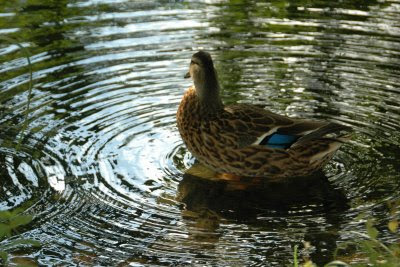 Once our tour of the house was over, we headed for the gardens. The house isn’t the only thing that is very, very large. I’m pretty sure I read that the current estate covers some 7,500 acres! Much of that property is farm land that they lease out and the money helps cover expenses for the upkeep of the estate. I’m not sure how much of the estate is given over to gardens, but Concetta and I spent at least an hour just wandering amongst the tree-shaded paths and enjoying the lake-side vistas. It was wonderfully restful and serene. I’m thinking of becoming a professional enjoyer of serenity in the future.
By tea time, Concetta and I had decided to have our big meal of the day in Burghley House’s dining hall. The dinning hall overlooks the rose garden and fountain (see photo 6) and provided an unbeatable setting for our dinner. Concetta finally got to partake of the lamb, something she’s been talking about since we were in Wales where all the sheep make their home. I, on the other hand, had the venison and dumpling pie with a football-sized bowl of veggies on the side. It was truly terrific. To reward ourselves for all the walking we’ve been doing, for dessert we shared a portion of “sticky toffee pudding,” which, if you’ve never had any, is like saying you’ve never made love. That dessert is FANTASTIC! The only reason I didn’t lick the plate is Concetta would have jabbed me with a fork.
 Anyway, that’s our adventures for today. By the time we left Burghley House it had started to drizzle a bit so we came on back to the B&B for showers, blogging, and a bit of reading before bed. Tomorrow, well, I don’t know where we’ll be tomorrow, but stay tuned, it’s bound to be something interesting.
Ciao, tutti.
 Well, we were really sad to leave Vickie and Peter’s Old Barn Guest House this morning. Here we stayed the longest, five days, as I wanted sufficient time to ride the train into London for three days. The train ride takes an hour each way, which naturally cuts into your sightseeing time. That left us with an additional day to visit local sights before we had to head north. But after five days Vickie had become an old friend, and Peter and I had had time for some lively discussions about politics and other stimulating topics.
It was somehow appropriate that the skies were gray and dull this morning with a hint of rain as we hugged and shook hands and reluctantly headed for the car. I am really, really going to miss Vickie’s home-made yoghurt each morning as well as the delightful home-made bread. In appreciation of all her kindness, we left a small present for her in our room that we hope she likes.
This morning we went ahead and ran without the GPS as I was pretty sure I knew about where I wanted to go. Our initial goal for the morning was the city of Cambridge. Although I didn’t have any particular place I wanted to see in Cambridge, I figured that it would be fun to just stroll through the streets. The expressways in the UK here are pretty darn easy to navigate. The signs are very clear, and if you make a mistake you just go to the nearest roundabout and swing back the opposite direction.
 Connie is not really a fan of the roundabouts, but I think they’re fun. Many times you don’t even have to slow down much as you thread your way amongst the oncoming traffic. Occasionally, I get beeped at for changing lanes in the roundabout, though often the lanes are not really marked. But I’m getting pretty good at charging right through without a second thought.
It turned out that our dead-reckon navigating was just fine as somewhere just after lunch time we landed right in the middle of old Cambridge. A few minutes later, we had found a parking garage, parked the car, and headed out on foot to stretch our legs and see what there was to see. Cambridge being a college town there were lots and lots of three distinct things: college kids; businesses that catered to college kids; and – what’s my favorite? – right on! Book stores. Naturally, we took full advantage of the latter.
 Concetta had just last night been reading about Vita Sackville West and Harold Nicholson, the owners of the Sissinghurst Castle and gardens. Well, since the two had written some 80 books between them, we thought it would be a cinch to find at least one of the couple’s books in Cambridge. Well, it was not to be, but we did find some bargains which should insure that the balance of our evenings in England will be filled with great reading.
After strolling the old town, buying yet another Scottish “flat” hat (I lost the last one in Tisbury), and picking up some presents, we started scouting for a place to have our afternoon tea. We’ve grown a little weary of pubs so we were happy to find a wonderful café with a French flare that served up some very fine food in addition to our usual tea. Then, as the afternoon was flying by, we headed for the car and our drive to Thurlby in Lincolnshire.
Naturally, before we had reached our destination we had already run into a historic site that we just had to see: an archaeological site called Flag Fen. At Flag Fen they have discovered some pretty incredible bronze age, iron age, and Roman artifacts. We got to see how my British ancestors were living 3,000 years ago, as well as stroll a piece of Roman road. In addition, they have reconstructed some of dwellings that these early Brits inhabited, which were
 pretty cozy inside since the day had gotten progressively colder. (See the “I’m cold” expression on Connie’s face top right). But the thing that impressed me the most was the wooden cart wheel they found on the site. At 1,300 B.C., it is the oldest wooden wheel ever found in England (see photos of ancient wheel and reconstruction of what it would have looked like when new, photos 2 & 3).
After our brush with antiquity, we headed back for the car and the last couple of dozen miles on the highway before we reached Thurlby. Thurlby is a very rural village on the edge of flat-as-a-table-top farming country. But by the looks of the brochure there is lots to see around here, including touring the magnificent house where they filmed many movies, according to our hostess, that require those Elizabethan estates as a backdrop. I snapped a photo out the bedroom window when we got here, since the sun was shining, and you can see what I can see right this minute.
Our new B&B is very nice and we’re the only guests at the moment. Wendy’s router is sorely in need of a signal booster as I can’t get on line from the room, but must go to the landing. The router is only about twenty feet away so it must be very weak. So, while I figure out how to get all this into the ether, I’ll say
ciao, tutti.
 Some of you may be wondering, at least the camera geeks are, just what sort of photo equipment I took along with me on this trip. Of course, I took the Nikon D70s that I originally purchased for our trip to Italy along with the Nikon 18-200 zoom lens. I decided on that lens because of its tremendous versatility, which meant I’d only have to take that one. More than one lens would require exchanging of lenses all the time. Since I had read that the worst enemy of digital cameras is dust, and that getting dust on your censor is going to inevitably show up on your photographs, I thought that eliminating lens changes would seriously reduce the dust possibility. You should, by the way, always keep this in mind before you buy a used digital SLR camera.
So, what else did I bring along? As you can see from the photo on the left, I brought a number of things. First of all I found a really great “tote” in which to carry my extra camera gear. I think in its prior life it was meant to carry shaving kit-type things. But the fact that it was a dual-zipper, nylon tote made it a really ideal container in which to pack other things.
To the right of the tote is the strobe for the Nikon. It’s most useful in places where the on-camera flash just won’t cut it. I don’t often carry it along, but when I do, the nylon case has a great belt loop which allows me to just thread my belt through it and it rides quite comfortably on my waist for those walks through dark cathedrals.
On the far right in the top row is the filter case. I purchased it at Gordon’s photo store in Carson City. It holds about six 72mm filters quite comfortably. In it I tucked two extra polarizer filters, a “half-orange” filter for making skies darker, and a full orange filter for God knows what. Other than trading out the polarizer, so far I haven’t used the others.
The left-most item on the bottom row is a hard-shell case that holds about 20 CDs or so. Into this case I put a dozen blank CDs, a couple of DVDs, and a burned CD with my books on it. In Italy I found myself having go to internet cafes in order to get connected. While there I’d convert my camera memory chips to burned CDs just to have a little extra insurance. This time I wanted to have the burning capability myself.
Item number 2 on the bottom row is the case holding the camera memory card reader. On this trip, if I don’t shoot many photos on a particular day, I usually just hook the camera directly to the laptop via a USB cable and transfer the pix that way. If, however, I do shoot a lot, then I use the card reader to save time. Also in this case is a thumb drive which I haven’t used yet.
The third item from the left is the camera memory card wallet. I also purchased this at Gordon’s for a nominal price. This little gem fits as many as eight memory cards when four of them are in the plastic holders, and you could get at least four more if you just inserted the cards as four of the pockets would actually fit two cards apiece. When I went to Italy I was constantly searching for the memory cards and I never really knew whether I had found them all. This time I numbered each individual card starting with #1. Then, as I filled up the cards I get the next card in numerical sequence, thus eliminating the uncertainty of which ones were filled and which ones were not.
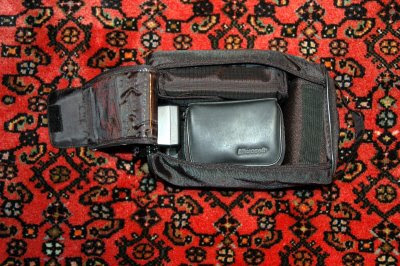 Fourth from the left on the bottom row is the battery charger for the Nikon battery. I learned the hard way in Italy that one never hits the street without an extra (charged) camera battery in ones possession. You should always make sure your spare battery is charged, of course. After a heavy day of shooting, put your spare battery in the camera and charge the one you used that day for use as the spare. That way you won’t have any unpleasant surprises.
The bottom photo shows you just how elegantly all these things fit into my “shaving kit.” Since the tote fits quite nicely into my carry-on luggage next to the camera bag with a slot left for the laptop to nestle in a special pocket behind the two of them, it packs nice and neat. To finish off the carry-on, I bought a nice zippered “envelope” about six inches by ten inches into which I put all the various cords and cables and plug conversion units for the UK. The whole thing is very compact and works very well.
Well, that’s the photographer’s tip for the day. Hope you find it useful.
 Today, our three days of train trips to London finished, we decided to have a day of rest. But while most people would take a good book and sit in the garden to rest, we decided to go visit gardens instead. Two were recommended to us and our B&B hostess, Vicky, put sticky notes on a map to show us just where to go. Ultimately, we would only have time for one, but before we headed out on our gardening quest, we went in search of a quite different form of art -- that of stained glass.
According to Vicky, quite near here was a church in the village of Tudeley which has been built on the foundations of an ancient Saxon church. And, if you know your history, goes back before the Invasion of William the Conqueror in 1066 A.D. After all, Robin Hood was a Saxon, wasn't he. I'm not just sure how long the present church has been sitting there on those Saxon foundations, but I found reference to the late medieval times. However old it is, that's not what I want to talk about. What I want to talk about are the windows which were crafted by the noted artist, Marc Chagall. Chagall was commissioned to do the windows to commemorate the untimely death of the twenty-one year old daughter of a wealthy local landowner. The windows were all pretty magnificent, but photo one is my favorite. The most astounding fact is that Marc Chagall was in his late 80s when he took on the job and completed the last four windows when he was ninety!!!
 From Tudeley we headed for the gardens of Sissinghurst. The grounds are referred to as Sissinghurst Castle, not because it had ever been a castle, but because at one point during the 1700s some French prisoners being kept there gave it that name. The few buildings that have survived are but a tiny remnant of what started out in the 1400s as a walled estate complete with moat. In the 1500s the then owner let the older estate fall down, and he built a completely new estate just to the north. Subsequent owners knocked down most of the buildings contained in the second estate with only about a 1/10th of the original structures surviving. By the third decade of the 20th century, a wealthy and talented couple, Nigel Nicolson and Vita Sackville-West, noted authors of over 40 books apiece, purchased the "Castle" and began to restore what was left of the structures and grounds.
 We had a simply marvelous time in the Castle gardens. As most English-style gardens are typically constructed, there are loads and loads of different "rooms" within the garden. Sissinghurst has ten rooms, including an all-white garden, an herb garden, and a cottage garden. Intertwining all these rooms are these wonderful brick and stone paths. For each room you often come around a corner and there, laid out before you, is yet another room. Often your specific room has a focal point, a statue, an urn full of daises, or water feature. Consequently, you can wander and wander and wander and never get tired of the view.
One of the things that impressed me most were the fig trees. Some of you might know that I recently brought home from California a fig tree that I hope I can keep alive in the sunroom. But at Sissinghurst, where Vicky tells us it can get to 2 or 3 degrees below zero, they are not only growing figs, but the plants appear to be thriving. Now I have renewed hope of growing mine outside. They appear to be giving them an edge by growing them against a house or garden wall. If you want to visit an English garden that is easy to find, easy to afford (if you have the Brit Heritage pass), and easy to recognize that it will live long in your memory, this is the one. Bring your camera and you won't be disappointed. Just outside of the garden they have an absolutely marvelous little cafe where you will be rewarded with some truly fine food, often made with ingredients picked right on the property. Concetta and just adored the place and would definitely recommend it to lovers of gardens and lovers of history alike.
 We stopped one other place on our way to Sissinghurst. Many of you know that I just love antique vehicles. So, when we passed a restoration shop on the way to Sissinghurst we, of course, pulled right over and wandered in to check it out. Thankfully, the chap with the grease rag in his pocket cheerfully welcomed us inside and gave us a rundown on each vehicle on display. The one pictured here is a Bentley and the mechanic declined my request to divulge the price. However, I suspect it's one of those cases where if you have to ask the price, you can't afford it.
Well, that's our day in a nutshell. If anything, I loved today better than all the others since I've been wanting to visit a garden ever since we landed on British soil. So, I finally had my wish, and all is right with world now. So, until tomorrow, I'll have to say,
Ciao, tutti.
Naturally, we couldn’t leave London without seeking out 221B Baker Street and paying a visit to Sherlock Holmes and Dr. Watson. Once again, we drove down to the Paddock Wood station and caught the morning train to London. This time we happened to catch the train destined for Victoria Station instead of Charing Cross Road and so ended up in a slightly different part of the city. Nevermind, we just pulled out our trusty map for the underground and set off for Baker Street anyway.
We didn’t get far. Almost immediately a Chinese man approached us with a forlorn look on his face and asked us to help him figure out how to buy a ticket for someplace in Kent. At least, that’s what we finally figured out that he wanted. He spoke virtually no English except he word “tiki,” which we assumed meant ticket. The poor guy had such a “deer in the headlights” look on his face that we couldn’t help but feel sorry for him. So, for the next twenty or thirty minutes we tried valiantly to figure out where he wanted to go (all he could do was show me the town name that somehow he produced on his cell phone screen) and how much a ticket might cost for that place, assuming it existed.
While legions of impatient passengers waited behind us in line, Concetta and I worked at deciphering the ticket machine, which, since we had purchased our tickets by mail, we had never needed to use. Thankfully, I finally figured the machine out and navigated my way through the menus while Concetta kept an eye on the guy’s luggage for him. But when the time came for him to insert his credit card to pay for the ticket I discovered that he had no such credit card. I tried to communicate to him that I would take the twenty-pound note that he was clutching in his hand and pay for it with my credit card, but I failed to get that message across. At that point we had to let the other waiting passengers get at the machine so I cancelled the transaction and we went our separate ways. We sure hope he eventually got where he was going, though I can’t see how he would. Too bad he didn’t study a few words of English before he embarked on his adventure. I’m going to take that to heart should I ever decide to head for China.
 So, our morning crisis over, we once again headed for the underground. All we had to do was ride the yellow or green line east to Westminster Station, then transfer to the gray line which would take us all the way to Baker Street. And that’s just what we did. Though the crush of passengers seemed to be just as heavy as we’d seen during the work-week, we managed to wend our way up and down the myriad of stairs, passageways, and escalators and get on the right train each time. Before we knew it, we were at Baker Street. We had hoped that our GPS would guide us from the Tube station to 221B, but the little machine only seemed to find a Baker Street in Scotland. So, we had to ask someone on the street which way to walk. Our quarry turned out to be just a block or so away, so we were soon standing out front.
 We had a really great time at the Holmes museum. Even though it’s basically a tourist trap, I loved the way they decorated the rooms to look like Mrs. Hudson’s house in the films. They even had a guy playing Watson upstairs and we had a really nice chat with him on the qualities of the various actors who have played both Watson and Holmes.
Naturally, after snapping a few photos I had to buy myself a “deerstalker” hat, just like Holmes wore in many of his movies. The hat might have been made in Finland, but I love it anyway.
After the Holmes museum we headed over to the nearby Regency Park to sit for a moment and collect our thoughts. But, as it turned out, the park was so beautiful that we decided to just walk a bit and enjoy the beautiful rose gardens. Everywhere, there were people strolling through the gardens or lounging on the lawns. We even saw a Japanese wedding party taking advantage of the Japanese garden area.
After our rose garden stroll, we left the park and stopped at a nearby bistro for a cup a tea, a shared sandwich, and our first ice cream of the trip. After all, they had pistachio. Who could resist?
 Since today was my day for picking our destinations, we now headed back to the tube station to catch a train for the London river-walk area at Westminster. Earlier that morning, while we were still at the Victoria Train Station, I had purchased two tickets for the London Eye, the huge Ferris wheel that dominates the skyline near the Themes. I felt that we just couldn’t come to London and not ride the Eye. As you can see, ride it we did. I just loved the experience. I found it so interesting that they load and unload the wheel without ever really stopping it. The wheel only pauses if they need to allow a handicapped person to enter or exit. I thought we might have to spend a lot of time in line, like at Disneyland, but in reality we virtually walked right on. Connie’s not so comfortable with heights, but the ride is so stable that she really wasn’t bothered at all, at least not until I asked her to go stand near the edge so I could take her picture.
After the Eye experience we decided that we had had enough of the hustle and bustle of the city for one day, so off we went to find the train station and enjoy a nice, leisurely ride back to Paddock Wood where our faithful Mini awaited us. After that, we spent some time trying to find a pub still serving food on a Sunday (they often quit at 4:00 p.m.). We visited three or four before we found one, but had a nice dinner and tried a new brand of ale called “Spitfire.” Don’t worry, we only had half a pint.
So, here we are, our day-tripping to London finished. Tomorrow we plan to visit some local sights here in Tunbridge Wells, Paddock Wood, and other nearby communities. I’d like to do more gardens if we can find one or two, and Connie has in mind a church that supposedly has some very nice stained glass windows. Tuesday is our travel day and well be heading for Lincolnshire. So, for now,
Ciao, tutti.
 This morning dawned bright and sunny as it has been doing for several days now. Hard to believe that just a couple of weeks ago we were thinking of trading the Mini Cooper in for a motorboat.
Once again we headed off for London on the morning train. This time, since it was Saturday, we knew there would be parking at the train station so we drove the car. We took a wrong turn at first, but soon recognized our error and made it to the station in time to catch the 9:45 heading north. As you know, we booked a B&B in the village of Tunbridge Wells for its proximity to the rail line since I was not planning to drive in London. The train ride has been a real pleasure. The trains are modern and smooth-running, and constantly inform you by voice and by LED just where you are and where you will be stopping next.
 Once in London, we knew just what to do and where to go this time. Yesterday, we chose to ride one of the red double-decker buses to our destination at the Imperial War Museum. Today, we wanted to immerse ourselves in the experience of "tube-riding" (see photo top right). Since I spent much time on the tube back in 1973, the technique soon came back to me. Down lots and lots of escalators -- don't forget to stand on the right so escalator-climbers can jog by -- and check out the multi-colored maps that tell you just what line to ride to get where you're going. We haven't tried changing trains yet, but if I remember right, it's pretty darn easy.
 We had the necessary cards to ride. They're the same ones you use to ride the red buses. Works great to get them in advance, just like the train passes. Then you just run them through the automatic reader and off you go. Down in the bowels of the subway system, it was pretty interesting to see tourists from all parts of the planet huddled around, staring at the maps, and deciding on their destinations. The system is so easy, I don't think anyone had a problem.
Our intended destination for the day was the British Museum (see photo #2 and #3 above -- Connie wanted me to say, 'Hi Maggie' from her on the steps in #3).
I'm sure you've begun to see a trend by now. Concetta and I like all that old stuff. But this time we were going for the really super old stuff. Contained in the British Museum is an immense amount of archaeological finds from everywhere on the globe that go back thousands and thousands of year ago. Specifically, we were interested in the collections centered on the Greek culture in southern Italy where Concetta's ancestors made their home. Most people don't know that the Greeks had a very strong presence in southern Italy and Sicily several thousand years ago, which probably insures that Concetta has some Greek ancestors if you go back far enough. Interesting that the very first words I ever said to her in that laudromat over 32 years ago were, "Are you Greek." I scare myself sometimes.
 Visiting these museums in Britain takes a lot of stamina, we have found. They just have millions of items on display. If you actually stopped to read the description of each display item, your visit would be measured in years not hours. Some of the most beautiful pottery, metal-smithing, sculpturing, and foundry work you'll ever see in your life can be found at the British Museum. My favorite things were the mosaics (see photo 4) and the sculpture (photo 5). I just can't imagine one human having sufficient time and talent to craft such beauty.
Considering that the mosaics are built using one tiny piece of stone at a time (the pieces are called "tesserae" after the Greek word for "four") it's hard to imagine just how long some of these intricate designs might take, not even counting how long it would take to make the tiny pieces of stone in the first place.
 The stone carving is just totally beyond my ability to understand how a mere human could turn out such beauty. You've probably seen lots and lots of sculpture in your life, but most are pretty heavily damaged after thousands of years of abuse and neglect. But many of the sculptures at the British Museum are in close to pristine condition. Absolutely amazing. I couldn't stop photographing them. Every once in a while I'd look around to see if the guards were taking an interest in me, thinking maybe I was casing the joint for a later late-night visit. But no one seemed to notice me.
You want to know the very best thing about the British Museum? It's this: as you walk through those hallowed halls filled with the cultural achievements of countless vanished cultures, you hear voices. Lots of voices. I suspect that almost as many modern cultures are present in that building each day as are on display. I heard French voices, Italian voices, German Voices, Japanese Voices, Chinese voices -- and a lot of voices I couldn't identify. They all were there, side by side, enjoying the collections in harmony. What we all wish people would do more often.
Sadly, we didn't stay long enough to do the Museum justice. But by 2:00 o'clock it was tea time and we had to stop. Then, after a nice lunch in the museum cafeteria, we did a bit of souvenir shopping. Finally, we headed for the tube station. For a while we thought of maybe trying to fit one more activity in before normal closing time, but in the end we caught the early train back to Tunbridge Wells and sought out an ale house for a spot of dinner. I had the "Cottage Pie" again as it often turns out to be pretty good. Concetta had the fish, but without the "chips" this time. And then it was home for an early evening and work on the blog. Wonder of wonders, I'm actually going to have this blog finished tonight before midnight. Tomorrow, hopefully, it's the Sherlock Holmes museum and the "London Eye." Can't wait. The time here has flown by and I suspect, just as we've discovered everywhere in the UK, a mere month over here is like taking one lick of an ice cream cone. It's just not going to satisfy us in the end. Guess we'll just have to come back, rent a rose-covered cottage down a country lane, and settle in for -- well, however long it takes.
Ciao, Tutti.
 Well, the weather has finally turned fine here now. This morning our B&B hostess delivered us to the local train station (see pix) and off we went to the magic city of London. I had pre-paid for 3-day train vouchers so we didn't have to figure out how to buy tickets at the station. We just waved our vouchers at the ticket agent and boarded the train. The ride was smooth and comfortable and we enjoyed it very much. I've always been drawn to the idea of taking the train to work every day and riding in comfort while I read my morning newspaper. The closest I ever got to it was when I lived in Chicago. Had I stayed in Chicago when I got out of the Navy, I might indeed have commuted to work via rail. Alas, it was not to be. But this morning I got to see just what it would be like as we rode amidst the many London commuters on their way to work.
 Concetta's request for the day's activities included the National Art Gallery (photo 2)and the Imperial War Museum. Both sounded okay to me so once we arrived at Charing Cross Station, we wandered out onto the sidewalk looking for clues to the proximity of our quarry and before long had literally stumbled over the National Gallery. It was only a half block from the station. The museum is free, however Concetta and I sprang for the cost of the audio tour to the tune of about fourteen dollars. The audio is really worth it as your eyes would probably give out long before you managed to read the captions under every painting. I say every, but it would take days and days to view every painting AND listen to the background and interpretation on each one. We viewed as many as we could, but didn't get much beyond the 16th and 17th century art. There's a wonderful collection there to see, but it would take many visits to do it justice. Around two o'clock we finally returned the audio gear and headed for the dining room for a spot of tea and a muffin.
 Once rested we set out to find the Imperial War Museum (photos 3 & 4). This destination proved more elusive. Just as I did with the train vouchers, I had purchased the necessary tickets to ride London's red buses months ago and they had been delivered by mail right to the house. It's definitely worth it to get these items in advance and save yourself the headache of trying to figure it out "in country."
There was only one problem: no one told us that specific buses stop only at specific bus stops. We thought naively that every bus eventually would come by the stop where we were patiently waiting. Well, after we had stood at the Trafalgar stop nearest the train station for thirty minutes without once seeing our Number 3 or Number 159 bus, we finally got smart and re-read the sign there. Yes, indeed, we had to go around the corner and wait at the correct bus stop before the 3 or 159 would be coming by. Well, once we got the little gray cells working properly it was a piece of cake to catch the bus and ride to the War Museum.
 For those of you who are wondering why Concetta might want to visit a war museum of all things, I'll tell you that she's been reading a couple of different series of novels, each of which takes place in the WWI time period. All the descriptions of miserable trench warfare, vintage flivvers hauling endless loads of wounded from the front lines, and cloth-covered Spads and Jennies winging overhead made her want to experience some of these things in person. And let me tell you, experience it we did. The Imperial War Museum has the finest depictions of warfare I've ever seen. The displays of uniforms, equipment, and firearms are second to none. Each display area comes complete with audio and video depictions in addition to masterfully-crafted display cases. I was just enthralled.
 One of the most moving exhibits in the museum is the one on the impact of war on children. Here we experienced the stories of thousands of displaced kids, many of whom were sent to other countries by Jewish parents caught up in the maelstrom of Hitler's advance into their respective countries. Most never saw their parents again. But British children also experienced separation from parents as many were sent into the countryside to live with friends, relatives, and even perfect strangers in hopes of saving their lives as the bombing of English cities took place.
We also toured the Holocaust exhibit. While we have not had an opportunity to view the Washington D.C. Holocaust Museum yet, we certainly found the story they told here at the Imperial very, very moving. The museum sought to individualize the stories with pictures and letters and personal items from the murdered people and through audio interviews with survivors as well as news footage shot by the Nazis at the time. It's not a "feel-good" experience, but one everyone should try and acquaint themselves with.
One high point at the museum for Concetta and me was the display devoted to the personal effects of Thomas Edward Lawrence (bottom photo). You may know him as "Lawrence of Arabia." Concetta and I have been fans ever since we saw the epic movie with Peter O'toole. To be just inches away from his uniform, weapons, and, most spectacularly, his personal motorcycle was just thrilling.
Sorry for the lateness of this post. I had it all done last night and suddenly Google just erased about 1/3 of everything I'd written and all but two of the photos. So, I had to do it over this morning.
Ciao, tutti.
 Today we bid a reluctant farewell to John, our host at Webster’s B&B in Salisbury, Wiltshire, England. Concetta and I thoroughly enjoyed all things about Websters. Even though all our hosts over the past two weeks have been friendly, accommodating, and eager to please, John impressed us with his enthusiasm, willingness to take time to chat, and for the obvious joy he took in running his guest house as expertly as he could. John and Veronica have one of best B&Bs we've encountered so far and I unhesitatingly recommend his home to anyone headed to Salisbury.
Unfortunately, leave we must as our next host was expecting us. But before we set our course for “The Old Barn” in Kent, I wanted to drop down to the coast, city of Southampton, and see if I might find a museum dedicated to the Titanic. Thanks to the GPS, it turned out to be rather easy to find (see top photo). Though I subsequently parked the car going the wrong way on a one-way street, for which a kindly “Bobby” left me a polite note, our navigation device guided us to within about 100 feet of the front door. Very cool!
As you know, Southampton was the last port of call for the Titanic before it set sale for America and its rendezvous with history. I’m sure everyone has seen a million documentaries about the ship and you might think, oh, well, why waste the time. But what I was interested in was more information on the human element in the story. Thankfully, I wasn’t disappointed. The museum had quite a bit of personal property of passengers and crew passed along by surviving family members as well as many, many personal accounts that often fail to make it to the various documentaries. Though museum rules prevented any photography inside, I can tell you that it was well worth the visit.
 Of course, after having spent over a year living aboard a boat myself, things to do with the sea always get my attention. But listening to the various biographies of many of the passengers and crew, both survivors and non-survivors, made our visit extremely interesting. Seeing the photographs of crewmen and reading their last cards and letters home had a huge impact on me, I’ll tell you. Museum staff seemed to think that there was still an old lady living in Southampton who was an eight month old baby when the ship went down and is the last known survivor.
After our visit to the Maritime Museum, Concetta and I next headed for the Archaeology Museum (photo 2)where we explored the three periods of early Southampton history. The city had its beginnings as an iron-age settlement, but the first major influx of people came with the Roman invasion around 43 A.D. The Romans turned Southampton into a shipping port and it prospered. After the decline of the Roman empire, the Saxons (probably the Jutes) came next and the settlement expanded as a trading center. Then, in the fourteenth century a wall was built around the city, some of which still survives. In fact, the Archaeology Museum we visit is located in one of the old guard towers from the wall. From that time to now Southampton has been one of the busiest ports and trading centers in the world.
 The last thing we did in Southampton was visit the marker erected to commemorate the departure of the Mayflower in 1620 (photo 3)for that place we all know and love, North America. One of the wonderful aspects of traveling in the UK is the age of everything you see. When we were in the Maritime Museum, one of the guides told us that their building was 400 years old when the Mayflower set sail just outside their door. The other night in Salisbury, we had dinner in a restaurant that had been a bar serving the workers who built the city’s cathedral over 700 years ago. Now that’s OLD! Fortunately, the food and ale was great and obviously hadn't been sitting around that long.
I missed out on my tea break today, but we had a very smooth drive from Southampton to our current five-day residence in Kent. Once again, the GPS took us door-to-door without so much as a hiccup. Tomorrow we hope to hop the train to London (I don’t want to drive it) and see the sights there. Stay tuned for adventures on the tube, the Eye, and, if Concetta gets her way, the War Museum.
Ciao, tutti
 I'm sure a lot of you are intrigued by the idea of taking a "driving vacation" in England. Probably you feel just the slightest bit intimidated by the thought of driving on the "wrong" side of the road over here in the UK, but I have to tell you that it hasn't been as scary as I anticipated. The thing to keep in mind is that everyone else is doing it right, which makes it easy much of the time to just do what everyone else is doing. In the beginning I had the most trouble if Concetta and I were traveling a little-used road and we were the only ones in sight. Then, when I finally encountered another driver, usually as we came sweeping around a blind curve, my brain would automatically insist that I needed to get to the RIGHT of the oncoming driver. This, of course, would have been disastrous. So, I had to learn to relax and try to "hush" my brain that kept insisting I was wrong. After a week I had pretty much fallen into the routine. However, it still sometimes unnerves me when I encounter that solitary driver at high speed.
 The expressways are a piece of cake normally. That's because there are few surprises and the lanes are wider. The biggest problem you will encounter is the narrow country lanes (see pix above right) and the narrow village streets. Both are often only one car width wide. It takes considerable creativity sometimes to thread your way along these narrow tracks while remembering to keep left. Sometimes you're up on the sidewalk. Sometimes you're in the bushes or literally off the road altogether. Sometimes you (or the opposing driver) have to back up to a driveway or other wide spot so one of you can pass.
Aside from clean underwear, our GPS is just about the best thing we brought with us on this trip. It relieves a lot of stress when you don't have to be juggling a map, a magnifying glass, your reading glasses, and a compass as you navigate down these tiny roads, even if you have a navigator.
 So far we've only had the GPS send us off on a wild goose chase once and that was tonight as we tried to navigate to a restaurant our B&B host had recommended. This time, the unit "thought" it had taken us to the right place, but no restaurant was visible. So, somehow, and we haven't figured out just how, it decided on a totally different destination for us. Thinking it had corrected its initial erroneous set of instructions, we let it lead us on a fifteen mile road rally that finished up at a tiny cottage down an impossibly narrow road that I suppose only the owner of the cottage ever traveled. It took a couple of re-programmings of the unit to make it come to its senses, but we finally arrived at the appropriate restaurant, considerably more hungry and lower on petrol, but otherwise none the worse for wear.
 As you can see by the second photo, Concetta and I visited Stonehenge this morning, something we both have been anxious to do for years. Though TV always makes Stonehenge look a lot larger in the documentaries, the stones are nevertheless very impressive. When you consider the weight of some of those blocks, its like those stone age craftsmen were moving two or three city buses around without the benefit of wheels -- and that's one piled on top of another. They don't let you get close to the stones anymore, but even so Concetta and I were quite moved by the experience and very appreciative of the audio tours that the British Heritage folks provide. By the way, if you're planning a trip to England/Scotland/Wales, be sure and purchase the British Heritage Pass. It gets you into over 800 sites for free.
After our morning admiring the awesome talent of my hard-working Celtic ancestors, Concetta and I next moved on to the village of Tisbury which lay just down the road. Tisbury is where my dad's mother's family were living in the early part of the nineteenth century. At that time the father, great great great grandfather, Joseph Burton was farming about forty acres. Knowing that I probably wouldn't be able to find the actual farm, I still wanted to prowl the streets of the village and maybe visit the cemetery (see pix #3)
 Turns out, Concetta and I had a great time talking to the locals at the library, in the street, and at the local pub where we had tea, sandwiches, and "spotted dick" for dessert. The town is absolutely charming, like something out of a story book. Concetta said we ought to buy a cottage and visit more often, but one look at the real estate prices and I think I could get something cheaper in Beverly Hills, or at least San Francisco.
Still, not even in Italy did we see such a wealth of traditional "rose-covered cottages" sitting amidst immaculately-manicured gardens and lawns (note the vintage Mini Cooper in the last photo). Everywhere we went we just instantly fell in love with the beautiful stone cottages, often with thatched roofs, and the wonderful greenery that we in Nevada would definitely kill for.
Well, we actually went on from Tisbury to visit the Salisbury Cathedral area, but I'm too tired now to add any more to the blog so, for tonight, I'll have to say
Ciao, tutti.
 Today we visited my long-time friend, Josephine, in her wonderful home in Poole on the southern coast of England. I met Josephine over 34 years ago when I spent some months on the island of Malta, her homeland, while our boat, the MAR, was in port for the winter. Though fate decreed that our paths would cross only briefly all those years ago, she has always held a special spot in my heart. She was 19 then.
 Today she's raised four children, three lovely girls and a boy, now serving with the Royal Marines.
This morning, Josephine took us on a long stroll around her town to see the picturesque harbor and marina areas, after which we retreated to her sunny kitchen and sipped tea and munched sweat rolls for the afternoon, all the while reliving tales of the "old days." Then, this evening, while keeping up
 a lively conversation with Concetta and me, Josephine managed to whip up a fantastic lasagna that would have won a prize in the best Italian (or Maltese) kitchen. The top pix is of Josephine's home in Poole, which she is currently remodeling, more or less, by herself. The second pix is Jo with the box of candy my shipmate requested I bring her. The last pix is of Jo and two of her three daughters, Elizabeth (left) and Stephanie (right).
Not many people know that if it wasn't for Josephine, Concetta and I might not have met. After living aboard the yacht MAR for a year, my shipmate, John, and I had decided that we had had enough of life at sea. But it was initially John whom we agreed would leave first and I would wait until the captain hired someone to fill John's spot before I left to come home. John, at this point, had known Josephine only briefly before we set sail on our summer cruise in 1974. But when the cruise was over and John and Josephine were re-united, he changed his mind and told me that he would stay on board longer and I might go ahead and leave. This I did in early August 1974. By August 15th of '74 I had started a new job in Carson City, and by the end of that fateful month of August I had met Concetta. So, you see, if I had stayed longer on the boat and John had come home first Concetta and I might never have met in that laundromat all those years ago.
Isn't fate a wonderful thing.
Ciao, tutti.
Today turned out to be an absolutely perfect day. This morning we bid farewell to southeastern Wales and we turned our little Mini Cooper back towards jolly old England. Our plan was to head for the city of Bath in the English midlands to visit the ancient Roman site in that city. Once on the highway, we soon discovered that Bath was much closer than we had thought. In the end, the trip took less than two hours. Piece of cake.
But as soon as we reached the city limits we had the misfortune to end up right behind a giant yellow school bus that, no matter how hard I tried, I couldn't seem to pass. At one point I was nearly rear-ended by another big bus behind us and the driver very quickly let me know just how much he appreciated how much I've learned about English driving so far.
Then a thought hit me. I wonder, "I said to Concetta, "if this darn school bus is headed to the Roman baths. Since we really don't know where the baths are, maybe we should just stay right where we are and follow him."
And that's just what we did. Minutes later the bus lead us right to the area we were seeking. Almost immediately we found a dynamite parking spot that didn't tax my ability to park a right-hand-drive car and we were soon headed off on foot.
 The first thing we encountered was a museum of historic fashions. Now Concetta was truly in heaven. Actually, I found it pretty interesting myself. You couldn't help but appreciate some of the workmanship that went into these clothes. Most impressive, they had a pair of gloves that were 400 years old, some of the oldest surviving fashion accessories in the world.
We were still at the fashion museum when tea-time arrived, so off we went to the museum cafeteria. Now, one of the culinary items we've been keeping an eye out for because Concetta has seen it on the cooking channel is something called "clotted cream." Well, this tea shop had the very item. So, tea today consisted of scones, clotted cream, and strawberry jam along with a lovely pot of English tea. Clotted cream, though I can't tell you what it is precisely, appeared to me to be something halfway between whipped cream and butter. But whatever it is, I sure liked it.
 After the tea break we followed the city's very precise and informative directional signs and soon came upon the Roman baths. Although everyone has at some time or another seen a documentary on the Roman city of Bath, me included, I was just blown away by the presentation there. It's nothing short of outstanding. The more I learn about the Romans and see their handiwork over here, the more impressed I am. One fact I remember is that 240,000 gallons of hot water a day flow through the Roman baths, even today. The Romans had hot tubs, steam rooms, cold plunges, and places where they could get rub downs and individual attention. Pretty neat for 1600 years ago.
After we toured the baths Concetta asked if we could try and find a glass-blowing shop she'd heard about. That sounded interesting to me, so off we went. We soon found someone who directed us and we found the shop without much trouble. Concetta loves glass blowing and I must admit that I find it pretty fascinating as well. For the sum of a couple of pounds they let you go back where the glass workers are plying their craft and watch as long as you want. Neat. Here's a couple of shots of the kid doing the work. Concetta asked him how he'd gotten into the business, thinking he'd say something romantic like, oh it was my calling since I was a child.
 However, the young artist said, "Well, I was out of work and my girlfriend threw the newspaper listing at me and told me to go get a job. I've been here ever since."
So much for romance.
After the wonderful glass-blowing demo, we decided to try and find the car since it was getting on to four o'clock and I wanted to try and be in Salisbury by five-ish. Here the perfect day continued unabated as on a whim I suggested that we take a sort of left turn and see if we'd end up anywhere close to where we started that day. Wonder of wonders, we practically tripped over the car fifteen minutes later. And that wasn't the end of our good luck.
 Almost right next to the car was something you see here a lot, a "Pay and Park" machine. I was supposed to have put in some money and put a parking slip on the dashboard. Unfortunately, I had totally missed the machine in my haste to park the car and get sight-seeing. Wonder of wonders, no one noticed. There was no parking fine on my window.
Once on the highway, we plugged the postal code for our Salisbury B&B into the our treasured friend, the GPS, and it soon had us out of the city and flying down the road toward the county of Wiltshire. Wiltshire is important in our itinerary because my dad's mother's family comes from the tiny village of Tisbury there. The Burtons were farmers in the early to mid 1800s and, for all I know, may yet be there as only a couple of the family members emigrated to America, my great grandfather being one of them. The remainder of the family stayed right here in England.
While we're in this area we also plan on visiting a person out of my distant past, a friend from the island of Malta whom I met way back in 1974 when I was living aboard a sixty-foot two-masted ketch in the harbor there. We're going to travel south to the seaside city of Poole tomorrow to see her and take in the sights.
Well, that's all for now. Concetta's been asleep for an hour and I better get to sleep myself.
Ciao, tutti.
 Well, here we are once more, sitting in McDonalds, hunched over a chicken sandwich, accessing the blog. You will remember that our present B&B doesn't have wireless, a mistake I won't make again. Originally, I chose this particular house because the hosts said that they could arrange for doing our laundry, a pressing necessity at this stage of the trip. But being away from the Internet is just too inconvenient when we always need to locate our next destination, usually based on the postal code that we feed into the GPS. But as the English say, never mind. Tomorrow we're off to Salisbury (where Stonehenge is found) and the B&B there is guaranteed to have the Internet.
This morning Concetta and I had an absolutely marvelous time touring, of all things, a coal mine. Before you throw up your hands in horror, let me tell you that seldom have we enjoyed such a professionally-run tour. First, we had to hand over anything on our person that might cause a spark, including cameras, cell phones, watches, and (believe it or not) the automatic key lock for the car. Then they gave us carbide lamps and hard hats. Finally they herded about a dozen of us into a cage suspended on the end of a wire cable and dropped us 300 feet into the bowels of the earth.
Then, for the next hour, we learned everything there is to know about coal-mining in the last century and before. Did you know that in Wales, the country that produced the finest coal on earth for decades, you could start working in the mines at age five -- boys or girls? Did you know that a five-year-old child would often be working in complete darkness, on a twelve-hour shift, and have a devilish job keeping the rats away from his/her lunch? Incredible!!!
Our guide in the mine, a twenty-five-year veteran of the mine, as were his father and grandfather before him, told us that if you got a working space of four to six feet headroom, you were in clover. If you got three feet of headroom, you were still okay. But sometimes you got as little as seventeen inches and had to work lying on your side with a pick. And, throughout most of the history of coal mining, you only got paid for coal you sent to the surface. You didn't get paid for just showing up. As an added bonus, you often had to walk as many as four miles to the coal face, something for which you didn't get paid. And, if you got hurt, as hundreds did, your fellow coal miners carried you out of the mine. No paramedics showed up. Not until modern times was there a hospital on the property. Here's the bombshell: Women as well as men worked in the mine, often on their hands and knees pulling or pushing loaded cars of coal. Everyone had to work or the family often had not enough to eat.
 In the afternoon, once we'd had our usual tea, we visited castles. One, was an 11th century ruin of a Norman castle which was restored by a wealthy industrialist in the mid 1800s. In fact, at the time, he was considered to be the most wealthy man in the world, mostly due to the industrial revolution that had made him rich. He owned, among other things, the dock area where all the coal and iron was shipped to other countries. He restored the castle we visited purely to use as a hunting lodge. The entire interior was magnificently gilded in bright colors and decorated with impressive artwork.
 Our second castle of the day was in the town of Caerphilly and looked the most like a real castle with a moat, draw bridges, and huge towering gates. The same rich man who restored the first castle also started restoration on the second, much larger castle, and restoration has been ongoing every since. It is the largest castle in Wales, the second-largest in Britain (second to Windsor castle) and is one of the largest fortresses in Europe. It was built mainly between 1268 and 1271, it is an early example of a concentric castle, meaning that there is a castle wall within the outer wall.

 Today we awoke to sunny skies in Thurlby -- well, more or less. Our new B&B, the home of Wendy Chouffot, is a small operation in that it only has two guest rooms available, which is nice. Right now Concetta and I are the only guests present, which is really nice. I originally chose Wendy’s B&B because she had agreed in advance to tackle our laundry at this point in the trip. Now that we’re here, we’re certainly glad we chose this one. Not only did Wendy cheerfully take on the laundry job, but she has been just as accommodating and friendly as any host we’ve had the pleasure of meeting. Plus, the house is immaculate and very cleverly decorated.
  One of the most interesting places to visit in this area, according to Wendy, is the Burghley House in the village of Stamford about a dozen miles away. Since I didn’t really have any specific activities lined up in advance, we took Wendy’s advice and set out for Stamford right after breakfast.
 This house is no ordinary dwelling. Both Queen Elizabeth and Queen Victoria were sometime guests there and had specific bedrooms named for them. They wouldn’t allow photographs to be taken, but the artwork inside is nothing short of incredible. Almost all the vaulted ceilings are painted in the Sistine Chapel style with scenes from Greek mythology and what can only be described as a lot of naked folks having a very good time. One room alone took two painters a year to complete, and that was a fairly small room. In one room, the painters had not only frescoed the ceiling, but all the walls as well. What an undertaking! Also on the walls are over 600 paintings, some of which are the size of an average living room rug.
  When we arrived at the chapel, which probably seated close to 50 people, a man was giving demonstrations on a couple of 18th century musical instruments, an pump organ (that had to be pumped by an assistant) and a piano. Both sounded lovely. The most astounding thing was when he confided to us that the music he was playing on the piano was a piece written by Mozart when the young composer was EIGHT years old. And that particular song was only one of forty that Mozart wrote that year!
  Once our tour of the house was over, we headed for the gardens. The house isn’t the only thing that is very, very large. I’m pretty sure I read that the current estate covers some 7,500 acres! Much of that property is farm land that they lease out and the money helps cover expenses for the upkeep of the estate. I’m not sure how much of the estate is given over to gardens, but Concetta and I spent at least an hour just wandering amongst the tree-shaded paths and enjoying the lake-side vistas. It was wonderfully restful and serene. I’m thinking of becoming a professional enjoyer of serenity in the future.
  Anyway, that’s our adventures for today. By the time we left Burghley House it had started to drizzle a bit so we came on back to the B&B for showers, blogging, and a bit of reading before bed. Tomorrow, well, I don’t know where we’ll be tomorrow, but stay tuned, it’s bound to be something interesting.


